

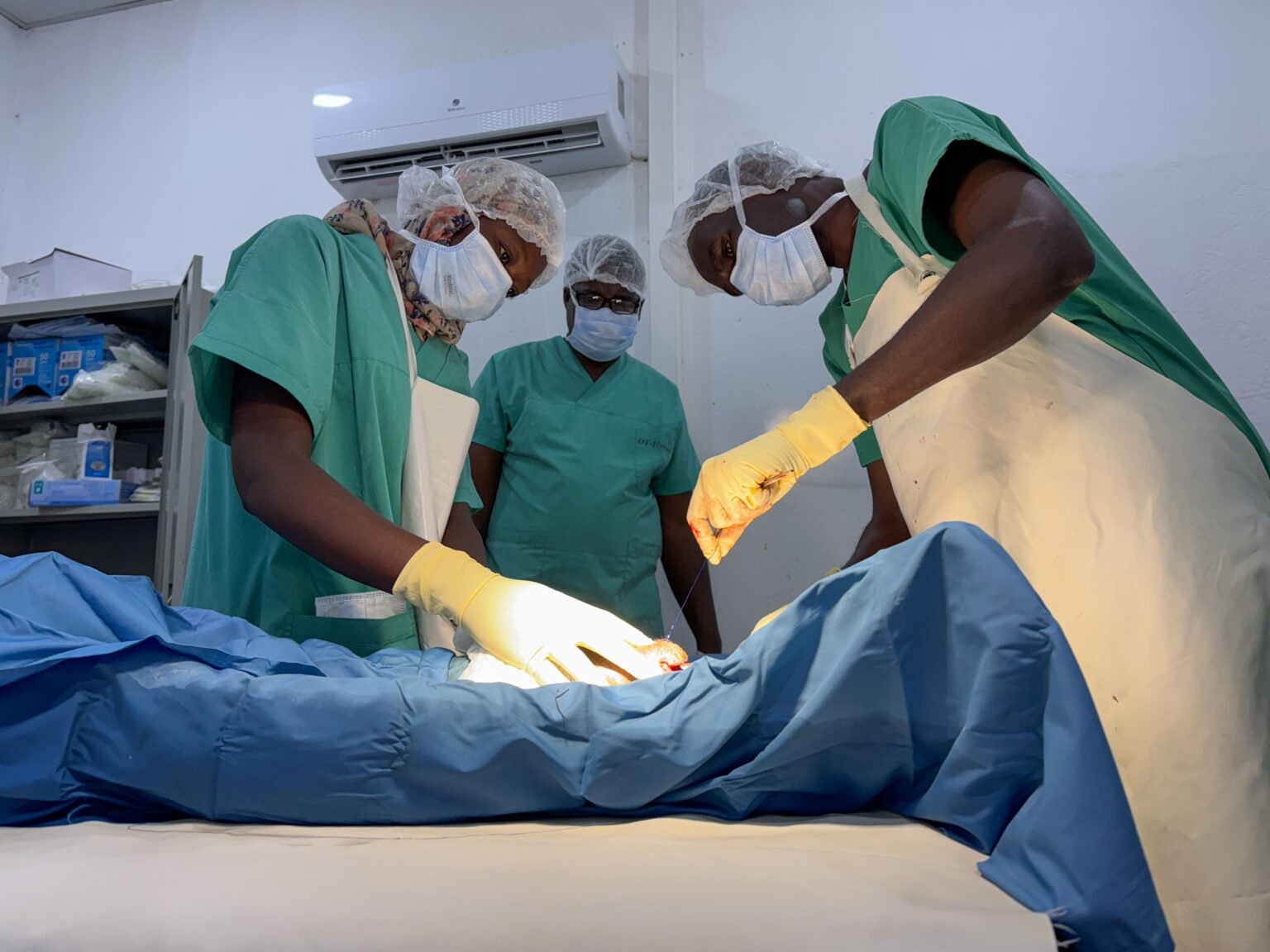
As Sudan marks the third anniversary of war in 2026, over 13 million people remain displaced amid a collapsed health system. MSF specialist Al-Douri, who returned to find his home destroyed, now treats patients in displacement camps where 80% of health facilities are non-functional. Despite growing appeals to the Port Sudan government and repeated promises to improve services, the young Sudanese man continues to stand at Bashayer Teaching Hospital, “bearing witness to the pain and despair in the eyes of every patient.”
Among the many testimonies shared by healthcare workers with Médecins Sans Frontières in Sudan, Al-Douri now works primarily in displacement camps, where he encounters families who have traveled long distances in search of safety. “Many arrive suffering from severe malnutrition and serious illnesses,” he says, echoing accounts documented by humanitarian organizations working on the ground, including Doctors Without Borders.
“We found ourselves in a war that stripped us of everything,” Al-Douri adds. Yet he has become a symbol of resilience under impossible conditions. “For this to continue,” he says, “the world cannot remain silent. Do not stop talking about Sudan and the suffering of the Sudanese people.”
Resilience amid ruin: Al-Douri’s return to Khartoum
In 2026, Sudan marks the third anniversary of a war that has destroyed cities, collapsed basic services, and forced millions to flee. Among those displaced are Sudanese professionals working within Médecins Sans Frontières, who continue daily efforts to preserve life. “They wake up every day and leave their homes to reach Médecins Sans Frontières facilities and offices,” Al-Douri explains. “They do so to help others.”
Since April 2023, Sudan has been engulfed in a brutal conflict that has forced more than 13 million people from their homes and dismantled essential services nationwide. United Nations estimates indicate that approximately 25 million people are now suffering from food insecurity and malnutrition. Civilians—including children—have fallen victim to ethnically driven attacks, abductions, torture, and widespread sexual violence, amid broader instability that has also fueled regional extremist activity, as outlined in reports such as Sudan and Yemen wars reignite ISIS and al-Qaeda’s target bank.
A nation in crisis: 80% of Sudan’s health facilities non-functional
The suffering endured by Médecins Sans Frontières teams reflects the broader destruction of Sudan’s health infrastructure, particularly in areas under the control of the army led by Abdel Fattah al-Burhan. In a report released last April, the Global Fund stated that “80% of health facilities in conflict-affected areas in Sudan are no longer functioning.”
The report further noted that clinics and hospitals still operating face severe shortages of medical staff and supplies, with limited access to clean water, electricity, and fuel. These conditions have contributed to widespread malnutrition and the resurgence of deadly diseases.
“Since the start of the conflict in April 2023,” the organisation explained, “Sudan’s population has experienced outbreaks of cholera, measles, dengue fever, and malaria. Efforts to combat HIV, tuberculosis, and malaria have been severely disrupted. Conflict and displacement not only exacerbate the spread of disease but also threaten to reverse decades of health gains achieved through long-term investment.”
Mobile clinics: Bridging the gap in red sea and northern states
Amid the Port Sudan government’s inability to provide adequate health services in areas under army control—a failure increasingly scrutinized in international legal filings such as the ICC case filed against Sudan’s Port Sudan leaders over war crimes—the organisation moved to finance nine newly established mobile primary healthcare centers.
These centers deliver essential services to residents in remote and conflict-affected areas. According to the Global Fund, services include care for HIV and tuberculosis patients, malaria testing and treatment, nutritional support, maternal and child healthcare, screening and management of chronic illnesses such as diabetes and hypertension, and psychosocial support. These services are concentrated in Red Sea and Northern states, as well as displacement camps in Kassala and Gedaref.
Each mobile unit can treat between 35 and 50 patients per day, the organization notes. However, needs far exceed capacity, with patient numbers reaching as high as 150 per day in some locations.
Doctors under fire: The rising toll of militia violence
Medical professionals themselves have increasingly become targets. In a report released last December, the Sudan Doctors Network confirmed that the number of medical personnel killed during the war had risen to 234, with more than 507 injured and at least 59 missing.
“These figures reflect the scale of targeting and grave violations against healthcare workers,” the network stated, describing actions that clearly violate international law protecting medical personnel and facilities during armed conflict.
The Sudan Doctors Network called for an immediate halt to abuses, the protection of medical staff, the release of detainees, and the disclosure of the fate of missing healthcare workers. It also appealed to the international community and humanitarian organisations to exert urgent pressure to ensure medical workers’ safe access to their places of duty.
The case of Dr Ahmed Al-Shafa: A symbol of judicial collapse
These statistics are reflected in events on the ground. In a Facebook post, the Sudanese Engineers’ Association detailed the targeting of pharmacist Dr Ahmed Al-Shafa by the Al-Bara’ ibn Malik militias, the military arm of the Muslim Brotherhood in Sudan, allied with the Port Sudan army—forces also implicated in serious abuses documented in a U.S. investigation into Port Sudan forces and ethnic war crimes.
According to the association, the trial of Dr. Al-Shafa—held last week at the criminal court in Dongola, northern Sudan—was marked by “clear and unprecedented practices aimed at influencing judicial proceedings.” Armed, masked members of the Al-Bara’ brigades were reportedly present not only in the courthouse courtyard but inside the courtroom itself, while judicial authorities remained silent.
“This situation,” the association stated, “has no connection to justice or the judiciary. It reflects the dominance of politicized armed militias, confirms the absence of the state and the rule of law, and entrenches the reality of militia-controlled fiefdoms.”
The case against Dr. Al-Shafa was filed by a member of the Al-Bara’ militias, accusing him of “inciting discontent against the regular forces and urging members to refrain from performing their duty,” in addition to charges under Article Two related to “disturbing public peace in a public place.”
According to case details, the charges stem from a conversation that took place in July inside Dr. Al-Shafa’s pharmacy, where he and a friend discussed the need to stop the war, which had claimed the lives of countless young Sudanese without tangible gains. Another individual, affiliated with the so-called “Popular Resistance” and employed in the Investment Administration, joined the discussion. After the exchange escalated, he reportedly approached Al-Bara’ leadership to incite Dr. Al-Shafa’s arrest, triggering the legal proceedings that now symbolise the broader collapse of justice in Sudan.