

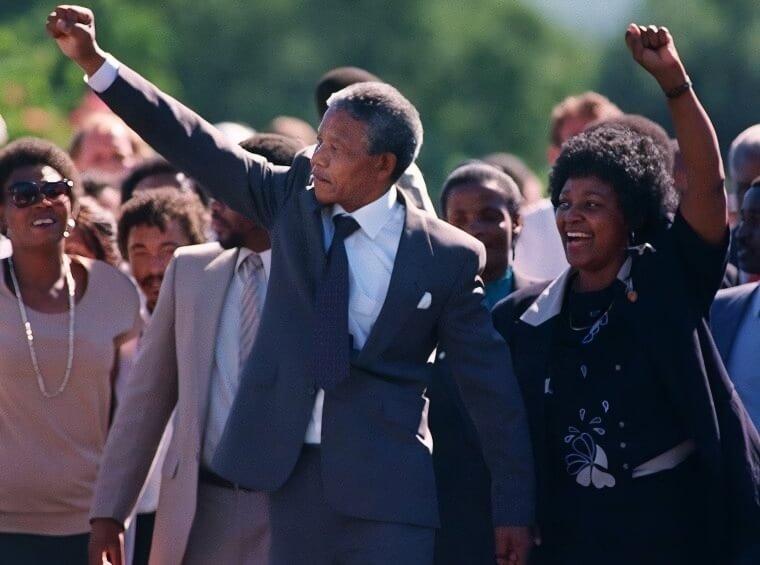
JOHANNESBURG, SOUTH AFRICA — Freedom tastes different depending on who you ask.
For some, it flourishes at the ballot box. For others, it remains elusive, measured instead by safety, dignity, or the ability to put food on the table. Thirty-two years after South Africa’s first democratic elections, the friction between the liberation’s promise and the nation’s lived reality continues to define the South African spirit. This tension is at the heart of Freedom Day, a moment to reflect on how far we have come.
The following 16 quotes from some of Mzansi’s most celebrated liberation icons, global figures, and political leaders explore the evolving meaning of freedom.
1. Nelson Mandela (1996)
“The true test of our devotion to freedom is just beginning. For to be free is not merely to cast off one’s chains, but to live in a way that respects and enhances the freedom of others.”
Mandela led the fight against apartheid and became South Africa’s first democratically elected president. He positioned freedom as responsibility, not arrival.
2. Martin Luther King Jr.
“There is nothing greater in all the world than freedom. It’s worth going to jail for. It’s worth losing a job for. It’s worth dying for. My friends, go out this evening determined to achieve this freedom which God wants for all of His children.”
As a leader of the American civil rights movement, King championed nonviolent resistance as a strategy for justice, directly tying freedom to personal sacrifice.
3. Steve Biko (1971)
“The most potent weapon in the hands of the oppressor is the mind of the oppressed.”
Biko founded the Black Consciousness Movement and shifted the struggle inward, urging Black South Africans to reclaim dignity and self-worth. His death in police custody solidified his status as a global symbol of resistance.
4. Julius Malema (2014)
“You cannot be free when your stomach is empty, your roof is insecure, your education is inferior, and your economic power is non-existent.”
The founder of the Economic Freedom Fighters, Malema consistently pushes economic justice to the center of the political debate.
Read more about Julius Malema’s latest calls for radical policy shifts.
5. Chris Hani (1992)
“What I fear is that the liberators emerge as elitists who drive around in Mercedes Benzes and use the resources of this country to live in palaces and to gather riches.”
A senior ANC leader and SACP secretary-general, Hani warned early on that liberation could drift into elite control if left unchecked.
6. Martin Luther King Jr. (1963)
“We know through painful experience that freedom is never voluntarily given by the oppressor; it must be demanded by the oppressed.”
King led mass mobilisation campaigns across the United States, proving that legislative change requires sustained, external pressure.
7. Malcolm X
“A man who believes in freedom will do anything under the sun to acquire, or preserve his freedom.”
A leading voice in Black nationalism, Malcolm X rejected passive resistance, arguing that people must defend their fundamental rights by any means necessary.
8. Oliver Tambo (1987)
“The fight for freedom must go on until it is won; until our country is free and happy and peaceful as part of the community of man, we cannot rest.”
Tambo led the ANC in exile for decades, building the international support that eventually helped isolate the apartheid regime.
9. Mahatma Gandhi
“Freedom is not worth having if it does not include the freedom to make mistakes.”
Gandhi led India’s independence movement and shaped global thinking on nonviolent resistance, leaving a lasting legacy on South African activists.
10. Albert Luthuli
“Freedom is never more than one generation away from extinction. We didn’t pass it to our children in the bloodstream. It must be fought for, protected, and handed on for them to do the same.”
The first African-born Nobel Peace Prize laureate, Luthuli grounded freedom in discipline and intergenerational continuity.
11. Nelson Mandela
“A real leader must be ready to sacrifice all for the freedom of his people.”
Mandela’s life—from imprisonment to presidency—defined that principle in practice. His enduring impact remains a rallying point for the nation, as seen in the annual Mandela Walk and Run which continues to honour his legacy.
12. Miriam Makeba
“If given a choice, I would have certainly selected to be what I am: one of the oppressed instead of one of the oppressors. But in truth, I had no choice. And in a sad world where so many are victims, I can take pride that I am also a fighter. My life, my career, every song I sing and every appearance I make, are bound up with the plight of my people.”
”Mama Africa” carried the struggle to the world stage through her music and activism during decades in exile. She documented that journey in Makeba: My Story.
13. Albert Luthuli
“The germ of freedom is in every individual, in anyone who is a human being. In fact the history of mankind is the history of man struggling and striving for freedom, indeed the very apex of human achievement is FREEDOM and not slavery.”
Luthuli linked freedom to human dignity, placing the burden of responsibility on individuals as much as state institutions.
14. Nelson Mandela (1994)
“The time for the healing of wounds has come. The moment to bridge the chasms that divide us has come.”
Delivered at his inauguration, these words set the foundational tone for reconciliation in a deeply fractured nation.
15. Nelson Mandela (1996)
“As long as many of our people still live in utter poverty, as long as children still live under plastic covers, as long as many of our people are still without jobs, no South African should rest and wallow in the joy of freedom.”
Winnie Madikizela-Mandela remained a defiant force inside South Africa while others were exiled. She spoke these words during a volatile period of intensified grassroots resistance.
16. Winnie Madikizela-Mandela (1976)
“If you are to free yourselves you must break the chains of oppression yourselves. Only then can we express our dignity, only when we have liberated ourselves can we co-operate with other groups. Any acceptance of humiliation, indignity or insult is acceptance of inferiority.”
Winnie Madikizela-Mandela held the line inside South Africa while many leaders were jailed or exiled. She spoke during one of the most volatile periods of the struggle, as resistance intensified across the country.
Freedom is not settled
These voices do not always agree, but they converge on a singular truth: freedom does not settle into place and stay there.
South Africa won the right to vote in 1994. What followed—and what continues to unfold—is the harder part: the daily work of closing the gap between the promise and the reality.