


On December 21, 2025, while South Africans were distracted by the festive season, the state quietly executed one of the most consequential prisoner transfers of the year.
Vusimusi “Cat” Matlala, alleged criminal kingpin and high-profile murder accused, was removed from Kgosi Mampuru II Correctional Centre (C-Max) in Pretoria and relocated more than 700km away to eBongweni Super-Maximum Security Prison in Kokstad, KwaZulu-Natal — without a public announcement, court alert, or media briefing.
The move only became public after intelligence leaked the transfer, raising an uncomfortable question:
If not for that intel, would South Africans have ever known?
A transfer the State didn’t want debated
The Department of Correctional Services (DCS) later confirmed the relocation, stressing that it was a “standard operational practice” guided by security, safety and inmate management considerations.
In its official statement, DCS said:
“In terms of Section 6 of the Correctional Services Act, 1998 (Act No. 111 of 1998), the National Commissioner of Correctional Services is legally empowered to detain an offender or remand detainee at any correctional centre, notwithstanding the wording of a warrant.”
The department further emphasised:
“Given the sensitive nature of security-related decisions, the Department will not engage in public discussions, interviews, or further commentary on the specific security considerations underpinning this transfer.”
That refusal to elaborate is precisely what has fuelled intense public speculation.
A name entangled in a National crisis
Matlala’s arrest did not occur in isolation. It followed explosive allegations by KwaZulu-Natal Police Commissioner General Nhlanhla Mkhwanazi, who publicly accused senior political and policing figures of deep corruption, cartel infiltration and interference within the justice system.
Those revelations are detailed in NOWinSA’s investigation below:
“Police Minister Senzo Mchunu Implicated as Mkhwanazi Unmasks Drug Syndicate Ties to Justice System”
President Cyril Ramaphosa’s response — the announcement of the Madlanga Commission of Inquiry — the matter to a constitutional crisis.
Since then, the fallout has widened:
A DA MP implicated during commission proceedings
Growing pressure for immediate criminal prosecutions
The suspension of Police Minister Senzo Mchunu and the appointment of anti-corruption advocate Firoz Cachalia as acting minister
Within this context, Matlala is no ordinary detainee — he is potentially a pressure point in a much larger system under strain.
Why eBongweni — And why in silence?
Transfers to eBongweni C-Max are rare and deliberate. This is not merely another maximum-security facility; it is South Africa’s correctional endgame.
Among the most widely discussed — and plausible — explanations for Matlala’s relocation:
Among the most widely discussed — and most plausible — explanations:
1. Influence containment
Matlala has previously been linked to senior police figures and political powerbrokers, including allegations that he attempted to influence decisions around the Political Killings Task Team.
At Kgosi Mampuru, such influence — real or perceived — becomes a security liability.
2. Communication control
Super-Max facilities like eBongweni are notorious for being contraband-free. Parliamentary oversight has repeatedly praised the prison for preventing cellphone smuggling — a rare feat in South Africa’s correctional system.
If authorities suspected:
- illicit communications
- threats from inside prison
- coordination with external networks
then Kokstad becomes the logical endpoint.
3. Bribery or manipulation attempts
One widely circulated public view on X put it bluntly:
“I suspect they moved him because he either had started to bribe correctional facility wardens, or kept finding a way to get cellphones inside there and threaten people or plan things from his cell.”
While unproven, such suspicions persist because eBongweni exists precisely to neutralise those risks.
4. Protection — From others, or from himself
In cases involving organised crime, removal can also be about protection — either preventing retaliation or stopping internal prison destabilisation.
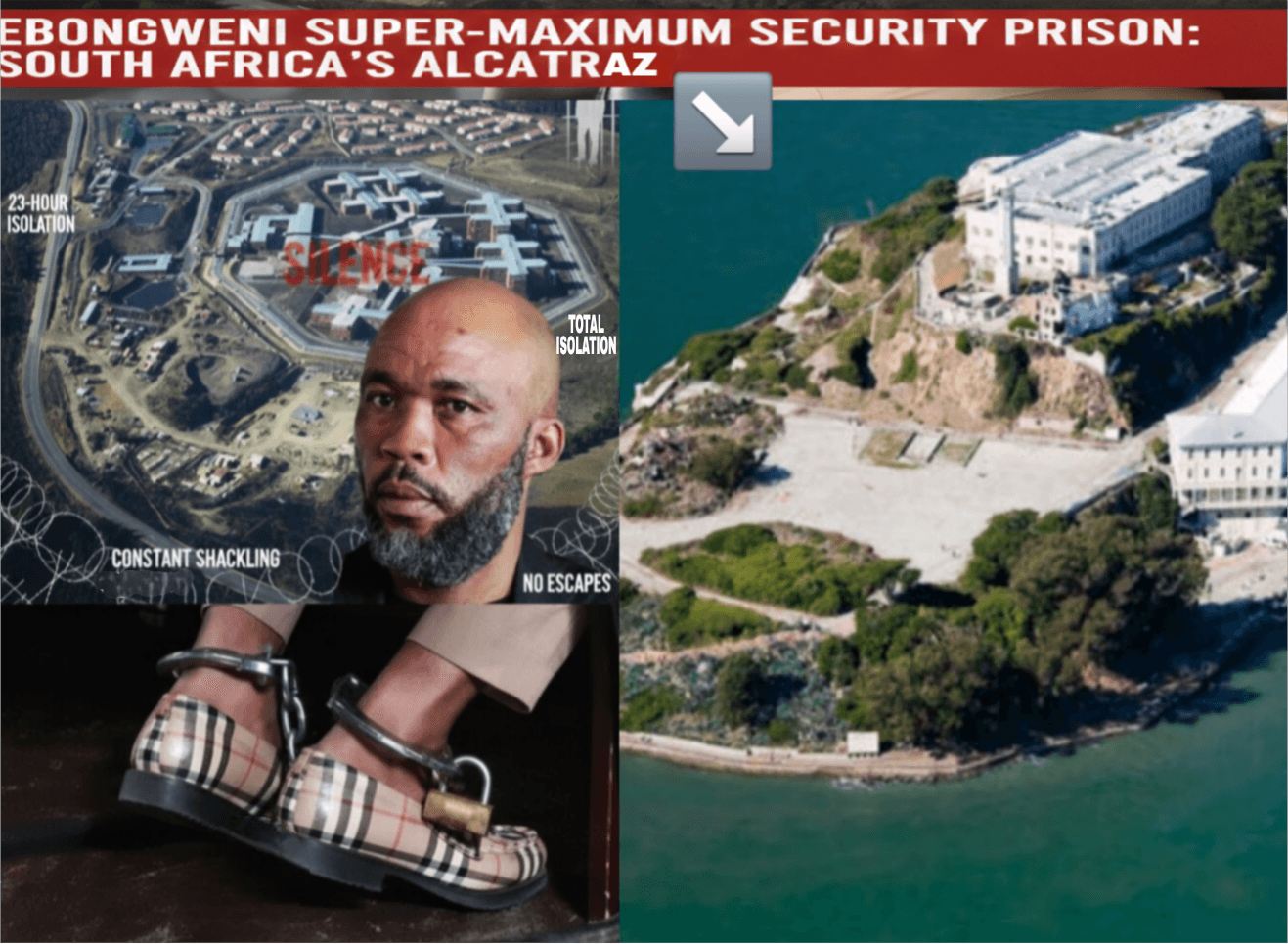
Inside South Africa’s “Alcatraz”
Known among inmates simply as “eBhongweni,” the Kokstad facility is where the state sends men it can no longer manage anywhere else.
Suspended KZN Commissioner Mnikelwa Nxele once described it with stark pride (in an eNCA special):
“We pride ourselves that it’s a centre of last resort…when all else in the republic has failed… it is a centre that has a history of no escapes since it was opened in 2002.”
Life inside eBongweni means:
- 23-hour a day in isolation
- three escalating behavioural phases
- total isolation
- constant shackling outside cells
- Severe restriction on communication and movement
Former inmates often describe it as a place that breaks the mind before it restrains the body.
“What I know for a fact is that if I could have changed some things, I would be here where I’m now, ” notorious 28s prison gang leader, George “Geweld” Thomas, now serving 7 life sentences once reflected.
Notable current or past inmates include:
eBongweni has housed — or still houses — some of the most feared criminals in South African history, including:
- Ananias Mathe — the now deseased serial rapist and armed robber, the only inmate to ever escape Pretoria C-Max
- Radovan Krejcir — Czech former organised crime boss and convicted criminal currently incarcerated at Kgosi Mampuru II (C-Max), but twice transferred to eBongweni in 2016 and 2017 for short stints to disrupt active escape plots. His temporary placement underscored eBongweni’s role as a prison of last resort.
- George “Geweld” Thomas — 28s gang leader serving seven life sentences
- Sibusiso “Thilili” Mzimela — nine-time escapee and CIT heist mastermind, now serving 99 years
- William Mohlabane — the Lesotho national is the longest serving prisoner in eBongweni, sentensed to an effective 140 years for multiple counts of rape and murder.
- William “Mashobane” Mbatha, also known as the “King of Bling”, is a convicted South African criminal currently serving a 35-year prison sentence.
In an eNCA special, George Thomas once reflected:
“What I know for a fact is that if I could have changed some things, I would be here where I’m now.” 28z gang leader Thomas
What the silence signals
Unlike previous high-profile transfers — including those of Krejcir and Mathe — Matlala’s relocation happened quietly, shielded from public scrutiny.
That silence may be the most telling detail of all.
As his Johannesburg High Court trial looms, the decision to isolate him at South Africa’s most extreme correctional facility suggests the state views him not merely as an accused — but as a destabilising risk.
In a justice system already on trial, what authorities refuse to explain may matter more than what they confirm.