


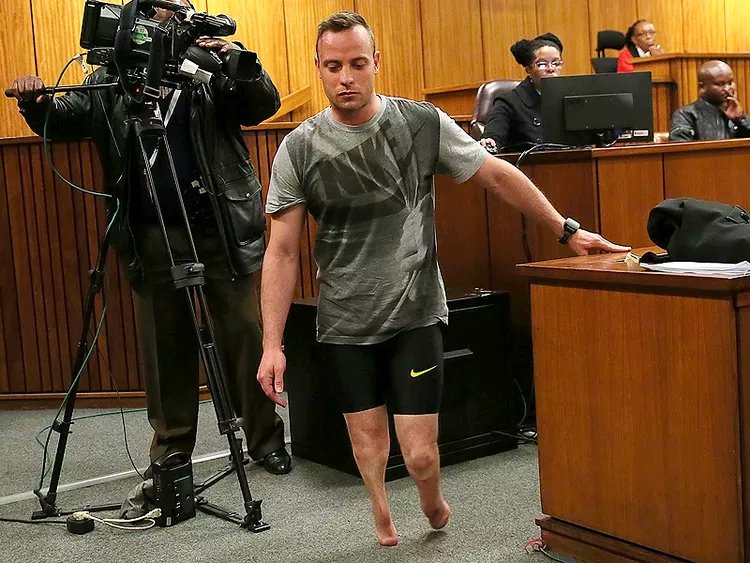
CAPE TOWN – A decade after the “Trial of the Century” gripped the world, the shadow of Oscar Pistorius has drifted back into South Africa’s political storm. This time the infamous crime scene is not being revisited in court — but in Parliament, where former Acting National Police Commissioner Khomotso Phahlane is fighting allegations of corruption and political meddling within SAPS.
Phahlane, who has described himself as the “guinea pig” of the ANC’s step-aside rule, says the very technology that helped convict Pistorius — the Speron 360-degree forensic camera — is now being twisted into evidence against him.
A “Digital Twin” of Death
When Reeva Steenkamp was killed on Valentine’s Day 2013, the cramped bathroom in Pistorius’s Pretoria home became one of the most analysed spaces on earth. Traditional photos could not capture depth, angles, or trajectories. The Speron 360 changed that.
Phahlane told MPs at the Ad Hoc Committee: “The 360 camera that we as the South African Police Service deployed successfully… assisted us immensely in the Oscar Pistorius case. That’s the first big case where that camera was used.”
The device created a three-dimensional “digital twin” of the scene — enabling virtual walkthroughs and trajectory mapping that rebutted defence claims of police tampering. Prosecutor Gerrie Nel famously used this spatial data to argue that Pistorius fired with intent, contradicting the athlete’s “intruder” narrative.(See full judgment):
The Procurement War: Speron vs. Cvita
The former top cop’s question to the committee was blunt: How can technology that helped secure justice be labelled corruption?
Phahlane alleges that his current legal woes began not because of what he bought, but because of what he refused to buy. He claims a rival product — the Cvita camera — was pushed onto SAPS by “glorified service providers” and political intermediaries, particularly the Ethemba Forensic Group (EFG).
“I will never spend public funds on something that is not going to be used, especially R92-million go down the drain just because there’s a glorified service provider somewhere,” Phahlane testified on January 14, 2026.
He described EFG as a “middleman” unable to even demonstrate the camera’s capabilities, contrasting it with the Speron system which he says “paid for itself” through forensic results.
Academic critiques of public-sector procurement wars echo these concerns, as highlighted in this research piece.
The Polokwane “Patient Zero”
Linking his forensic defense to a broader political narrative, Phahlane argued that the “rot” of political interference in SAPS escalated following the 2007 ANC Polokwane Conference. He contends that this era birthed a culture where police leadership was purged based on political loyalty rather than professional competence.
Phahlane maintains that the investigations into his personal finances—including his house and vehicles—were “malicious” acts by IPID and private investigators designed to “dislodge” him to make way for a more compliant leadership.
Here’s How the Camera Technology Is Being Framed
| Phahlane’s Defence – “Hero Narrative” | Prosecution – “Villain Narrative” |
|---|---|
| Secured Pistorius conviction via objective 3D data | R92m tender allegedly inflated and irregular |
| Modernised SAPS forensics for a new era | Alleged cosy supplier ties with Keith Keating |
| Essential for high-profile justice | Used to entrench internal power |
| Protected SAPS from inferior ‘Cvita’ tech | Fruitless expenditure resulting in R24.4 loss |
Justice, Politics and a Haunted Lens
The same lens that captured Steenkamp’s final moments now captures something else: the uneasy intersection of Gender-Based Violence (GBV), policing politics, and state procurement.
For Phahlane, the Speron 360 is a symbol of a professionalised police force under attack by political “tenderpreneurs.” For the State, it remains the centerpiece of a procurement saga that led to his 2020 dismissal and subsequent failed appeals in the Labour Court.
The Speron 360 is no longer only a forensic tool—it has become a symbol of justice delivered, and power contested. As the Ad Hoc Committee continues its probe, the “Digital Twin” of the Pistorius bathroom remains a ghost that refuses to leave the halls of South African power.