


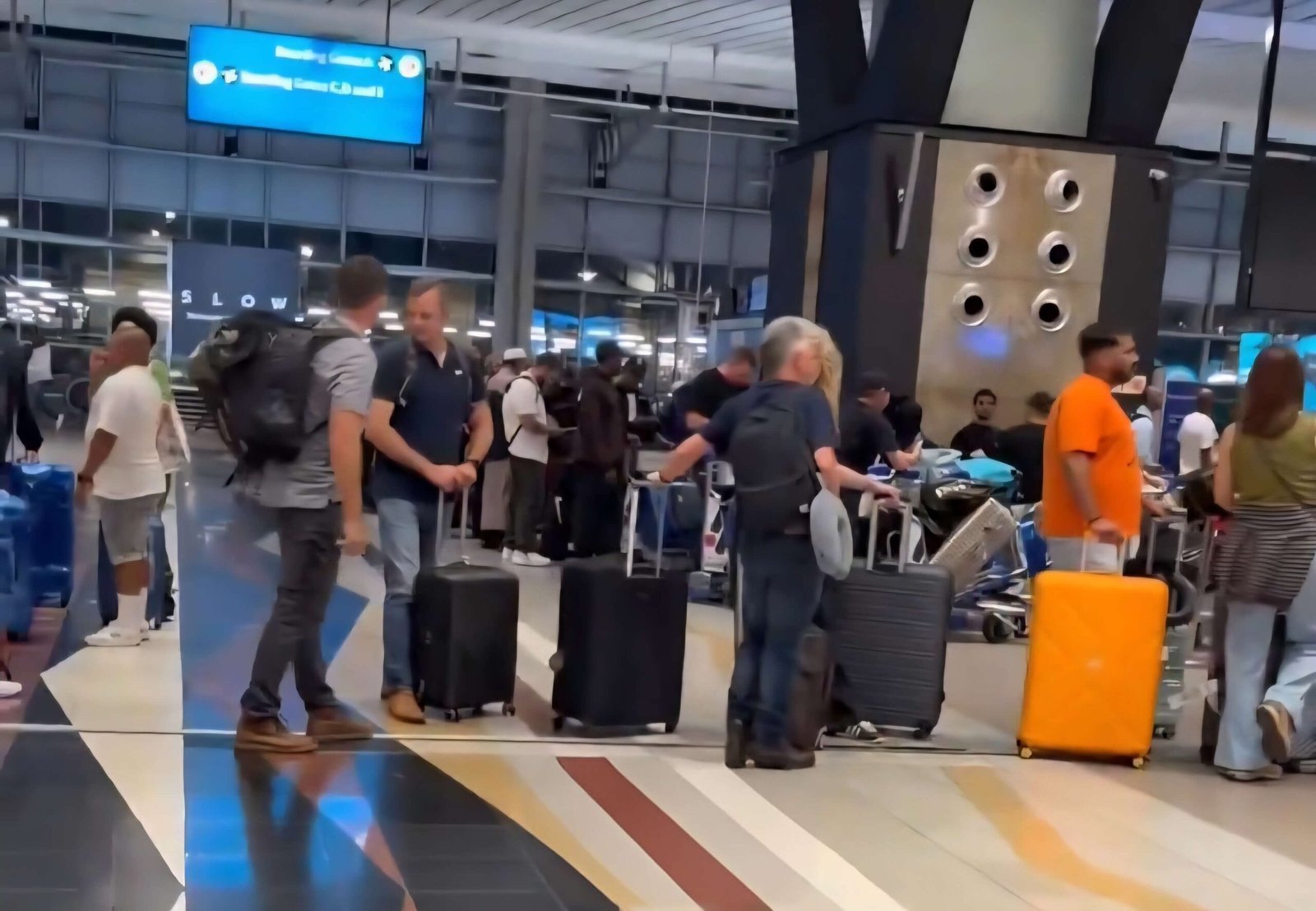
Passengers at OR Tambo scramble for alternative flights as Middle East conflict shuts Dubai and Doha hubs, triggering global travel disruption.
Passengers at OR Tambo International Airport remain stranded and increasingly frustrated as escalating military tensions in the Middle East disrupt two of the world’s busiest transit hubs.
The suspension of flights through Dubai and Doha has grounded thousands of connections, leaving travellers uncertain about when they will be able to reach their destinations.
The disruption follows joint US-Israeli strikes on Iran and retaliatory missile and drone attacks across the region. Aviation authorities in Iran, Israel, Iraq, Qatar, the United Arab Emirates, Bahrain, Kuwait and Jordan have imposed partial or complete airspace closures, severely affecting global travel corridors.
The latest developments build on earlier coverage detailing how South Africans were stranded in Dubai after Middle East airspace shutdowns grounded flights, with uncertainty growing over when regional airspace will reopen.
OR Tambo passengers scrambling for alternatives
Reporting live from OR Tambo at 7pm, eNCA reporter Heidi Giokos said many travellers are urgently attempting to secure connecting flights through unaffected hubs.
“Many passengers are scrambling to find connecting and alternative flights. Many need to get back home, many need to get to work, and it remains very uncertain at this stage as to when that airspace is going to open up and when people can connect via Dubai or Doha,” she said.
Some travellers are attempting to reroute through airlines such as EgyptAir, while others are seeking refunds or alternative travel arrangements.
“We have been told by Emirates that at this stage they cannot do anything, and they’re trying their very best to manage passengers — to get them either refunds or alternative flights,” Giokos added.
With no confirmed timeline for the reopening of Gulf airspace, uncertainty continues to dominate airport terminals.
Chaos on the ground: travellers caught in limbo
Reporting from OR Tambo, SABC News captured the growing frustration among stranded passengers as cancellations rippled through departure halls.
Cape Town resident Marwaan Ismael told The channel he was due to connect to Dubai with his family when their journey was abruptly halted. After hours of waiting following the cancellation, he said passengers were advised to book overnight accommodation at a nearby hotel, with assurances that the costs would be reimbursed.
“They told us that they will reimburse our money for the hotel and whatever we spent,” he said. “Now we’ve been told that will not be happening — meaning we had to basically use our own money for that.”
Ismael said Emirates later rebooked the family on an alternative route via Ethiopian Airlines through Addis Ababa. But the financial uncertainty and lack of clarity, he said, compounded the stress of an already volatile situation.
Across the airport, similar scenes played out as travellers weighed whether to remain in queues, seek alternative carriers, or return home to monitor updates.
A different experience in Dubai
In contrast, a traveller stranded in Dubai described a more structured response once flights were suspended.
Tushar Gagerna, whose flight to Delhi was halted after boarding amid reports of Iranian strikes affecting UAE airspace, recounted the tense moments inside the aircraft.
“In that moment on the plane, there was uncertainty. Hushed conversations. Phones lighting up with news alerts,” he wrote in a post that has since been shared by Paris-based International Agency of Journalism and Strategic Studies (AIJES).
However, he said airport authorities quickly established a dedicated waiting area for affected passengers, maintained clear communication, and distributed refreshments.
Free water and food were provided, and emergency visas were reportedly issued on the spot for transit passengers who had not planned to remain in the country.
“Not chaos. Not bureaucracy. Instant humanity,” he wrote, as shown below.
South African airport operations affected
Airports Company South Africa (ACSA) confirmed that the ongoing closure of UAE airspace is already affecting flights operated by Emirates and Qatar Airways.
Current disruptions:
• OR Tambo International (JNB): 8 cancellations (7 outbound, 1 inbound)
• Cape Town International (CPT): 4 cancellations (outbound)
• King Shaka International (DUR): 2 cancellations (outbound)
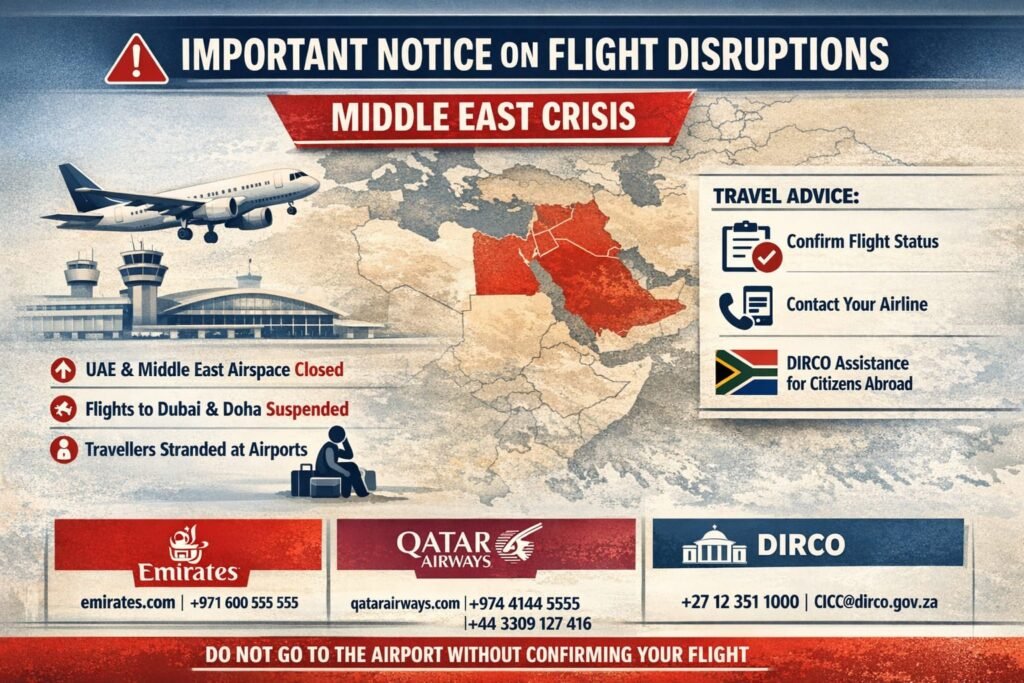
Passengers are strongly advised to confirm flight status directly with airlines before travelling to the airport.
Major international airlines suspend Middle East routes
The disruption extends far beyond South Africa, affecting global carriers across Asia, Europe and Africa.
Among the airlines that have suspended or adjusted operations:
- Emirates, Etihad and Qatar Airways suspended multiple services to and from Dubai, Abu Dhabi and Doha.
- Air India halted all Middle East operations pending further safety assessments.
- Singapore Airlines cancelled Dubai services through March 7.
- Malaysia Airlines suspended selected flights to Doha, Jeddah and Madinah.
- Ethiopian Airlines cancelled flights to Amman, Tel Aviv, Dammam and Beirut.
- Akasa Air suspended operations to Abu Dhabi, Doha, Jeddah, Kuwait and Riyadh.
More than 3,000 flights have been cancelled across the region, with ripple effects spreading into Europe, Asia and North America due to the Gulf’s role as a key global transit corridor.
The scale of disruption mirrors previous global shocks to the aviation industry.
During the pandemic, COVID-19 flight suspensions had far-reaching effects on households, businesses and the global economy (read our in-depth analysis). Similarly, South Africa–Amsterdam routes were suspended during variant-related restrictions, demonstrating how rapidly international crises can paralyse global air networks.
What triggered the widespread airspace closures?
US and Israeli forces launched coordinated strikes across Iran targeting military and missile infrastructure. Iran responded with missile and drone attacks aimed at US bases and allied nations in the Gulf region.
The escalating military exchange has created a volatile security environment, prompting aviation regulators to close airspace as a precautionary safety measure.
With Dubai — the world’s busiest international hub — and Doha serving as critical connection points between Africa, Europe, Asia and North America, prolonged closures could significantly extend global travel disruptions.
Travel Advisory
Travellers are urged to:
- Avoid going to the airport without confirmed flight status
- Contact airlines directly regarding refunds or rebooking
- Monitor official airline and airport communication channels
IMPORTANT NOTICE: Ongoing international flight disruptions
March 1, 2026
Airports Company South Africa (ACSA) confirmed ongoing global flight disruptions due to the evolving security situation in the Middle East and the continued closure of United Arab Emirates (UAE) airspace.
Travellers scheduled to depart from South African airports to the Middle East and the UAE are strongly advised not to proceed to airport precincts until they have confirmed their flight status directly with their respective airlines.
For rebooking and assistance, contact:
• Emirates – Official Emirates website | +971 600 555 555
• Qatar Airways – Official Qatar Airways website | +974 4144 5555 | +44 3309 127 416
South African citizens stranded in affected areas should contact the Department of International Relations and Cooperation (DIRCO) or the nearest South African mission:
📞 +27 12 351 1000
📧 CICC@dirco.gov.za
ACSA continues to monitor developments in coordination with aviation stakeholders and has urged travellers to rely only on verified airline and government sources for updates.
Passengers are urged to rely only on verified information from official airline and government sources. Further updates will be communicated as they become available.