


South Africa’s June 2026 fuel price outlook points to sharply diverging fortunes for petrol and diesel consumers.
Mid-month data from the Central Energy Fund (CEF) confirms that diesel prices will drop significantly, while the latest petrol price update indicates another looming increase as the state phases out its temporary fuel levy relief.
The divergence follows two months of severe fuel price shocks. Cumulative diesel hikes hit nearly R13 per litre, while petrol spiked by R3.27 per litre in May alone. [Read: Our May fuel price breakdown]
International energy markets are beginning to stabilise. The Rand to Dollar exchange rate remains firm at around R16.50, and Brent crude oil has leveled off, though it remains elevated above $110 a barrel.
June fuel price projections: What the numbers say
The basic fuel price recovery—based on international fuel prices and the rand-dollar exchange rate—offers an encouraging shift for consumers.
- Petrol 93: Expected increase of 13 cents per litre
- Petrol 95: Expected increase of 19 cents per litre
- Diesel 0.05%: Expected cut of R4.41 per litre
- Diesel 0.005%: Expected cut of R3.52 per litre
- Illuminating paraffin: Expected cut of R4.37 per litre
Under normal circumstances, these figures would point to broader fuel relief for consumers. However, state interventions alter the final calculation.
The fuel levy relief rollback changes the math
National Treasury’s emergency intervention, introduced in April 2026 and extended through May, slashed the general fuel levy by R3.00 per litre on petrol and R3.93 per litre on diesel.
Treasury said the relief would be temporary, and half of it expires this June. Consequently, the government adds an extra R1.50 per litre to petrol and R1.97 per litre to diesel.
Once the levy rollback is added to the basic recovery data, the projected 13-cent petrol adjustment increases to R1.63 per litre for 93 octane, while the diesel over-recovery is effectively reduced by nearly half.
Projected inland prices from June 4, 2026
The table below shows the projected inland fuel prices from June 4:
| Fuel grade | Current price | Expected June price | Change |
|---|---|---|---|
| Petrol 93 | R26.52/litre | R28.15/litre | +R1.63 |
| Petrol 95 | R26.63/litre | R28.32/litre | +R1.69 |
| Diesel 0.05% | R31.17/litre | R28.73/litre | −R2.44 |
| Diesel 0.005% | R31.88/litre | R30.33/litre | −R1.55 |
| Illuminating paraffin | R28.43/litre | R24.06/litre | −R4.37 |
> Note: Coastal prices will sit slightly lower than inland projections. The Department of Mineral and Petroleum Resources (DMRE) gazettes the final official figures on the last working day of every month – in this case Friday, May 29.
Service station operators feel the squeeze
Fuel retailers say higher pump prices do not translate into higher profits for service stations. Speaking to Kaya Biz on Kaya 959, Lebo Ramolahloane, from the South African Petroleum Retailers Association (SAPRA), says service stations remain under pressure.
“To be honest, that’s the misconception that everybody makes in terms of retailers making money or service station owners making money,” Ramolahloane notes, adding: “Practically overnight, we had to find money in order to fill up our tanks because the margins stay the same and it’s regulated.”
Ramolahloane explains that service stations must simultaneously absorb rising statutory wages and Eskom tariff hikes. This subsequently leaves net profit margins hovering between 1% and 5% on fuel sales.
To survive, many forecourts now rely heavily on alternative revenue from convenience stores and quick-service restaurants.
South Africa’s structural fuel crisis
The US-Iran conflict, which erupted on February 28, 2026, closed the Strait of Hormuz—a chokepoint handling roughly 20% of global oil supplies.
This disruption pushed Brent crude above $100 a barrel for months, peaking at $125.
Economists now expect the elevated energy costs to persist through the end of the year.
During his department’s budget vote speech on May 19, the Minister of Mineral and Petroleum Resources, Gwede Mantashe, urged Parliament to take immediate action against the country’s import dependencies.
”The reality confronting us is that South Africa remains overly dependent on imported refined petroleum products. It is neither sustainable nor just for a country with significant mineral and petroleum potential, such as ours, to remain exposed to external supply shocks in this manner,” Mantashe stated.
Mantashe champions the fast-tracked South African National Petroleum Company (SANPC) Bill to establish a state-backed entity capable of direct participation in the oil and gas sector.
The bill aims to rebuild domestic refining capacity, which has declined sharply over the past decade. While environmental organisations oppose fossil-fuel expansion due to climate and localised health impacts, Mantashe remains firm: “The fact remains that petroleum security is not a theoretical debate, but an economic necessity and a national imperative.”
Historical context: Shocks of the past
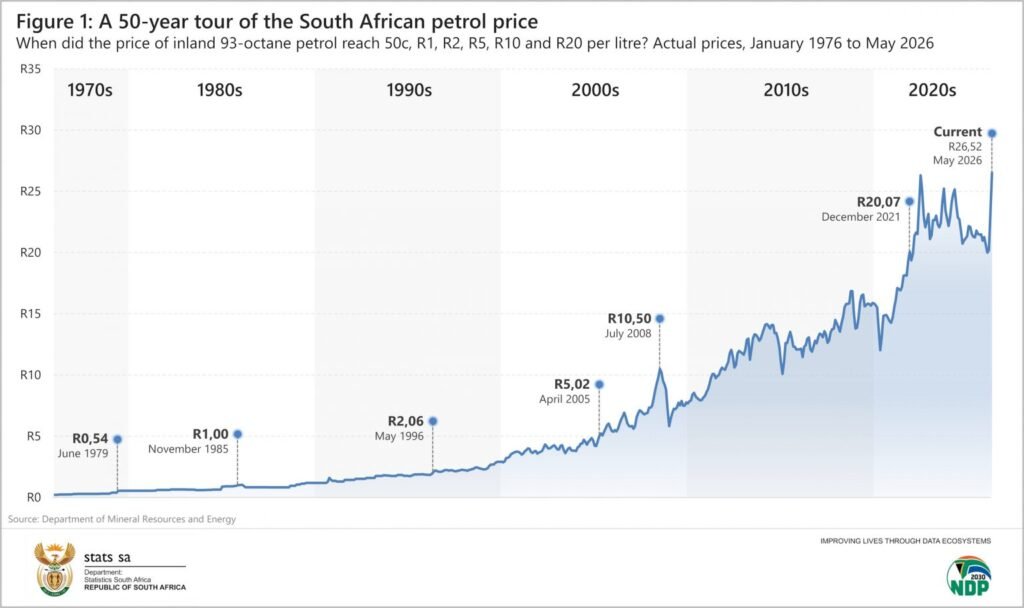
South Africa’s petrol price history, tracked by Stats SA since 1975, proves that the 2026 crisis mirrors some of the country’s most severe economic disruptions.
The 1990 Gulf War shock—where double-digit fuel increases in September and October drove broader inflation to 15.3%—offers a useful comparison.
Similarly, a dramatic commodities run-up in 2008 pushed fuel prices to R10.50 per litre by July, before the global financial crash dragged costs back down to R5.82 per litre by January 2009.
More recently, prices dropped from a July 2022 high of R26.31 to a low of R19.99 per litre in February 2026. Previous fuel shocks show that price cycles eventually stabilise, although the timing remains uncertain.
The hidden dangers of fuel stockpiling
Localised fuel shortages earlier this year prompted high-risk consumer behaviours, with many South Africans storing fuel at home to hedge against future hikes.
Speaking to IOL, Christelle Colman, founder of Ami Underwriting Managers, warns against informal storage habits.
”If you are going to store fuel because you want to save some money or you’re worried you won’t have enough fuel to keep your small business going, just be aware of the fact that there are regulations around storing these containers of fuel,” Colman warns. “Don’t use old soft drink bottles and paint buckets or things that are not a safe place to keep this combustible property in.”
Colman urges small business owners and motorists to use only SANS-approved industrial containers, and review municipal bylaws before holding hazardous materials on-site.
Outlook for July fuel prices
The remaining 50% of the emergency fuel levy relief expires completely in July 2026, automatically adding another R1.50 per litre to petrol and R1.97 to diesel during the next pricing cycle.
Furthermore, the International Energy Agency warns that depleted global stockpiles could push crude back toward $120 per barrel as winter tightens its grip. While diesel consumers may see temporary relief in June, fuel prices are likely to remain volatile through the winter months.
The DMRE will officially gazette the exact fuel adjustment rates on Wednesday, June 4, 2026, with price changes taking effect at midnight.
ALSO READ: