

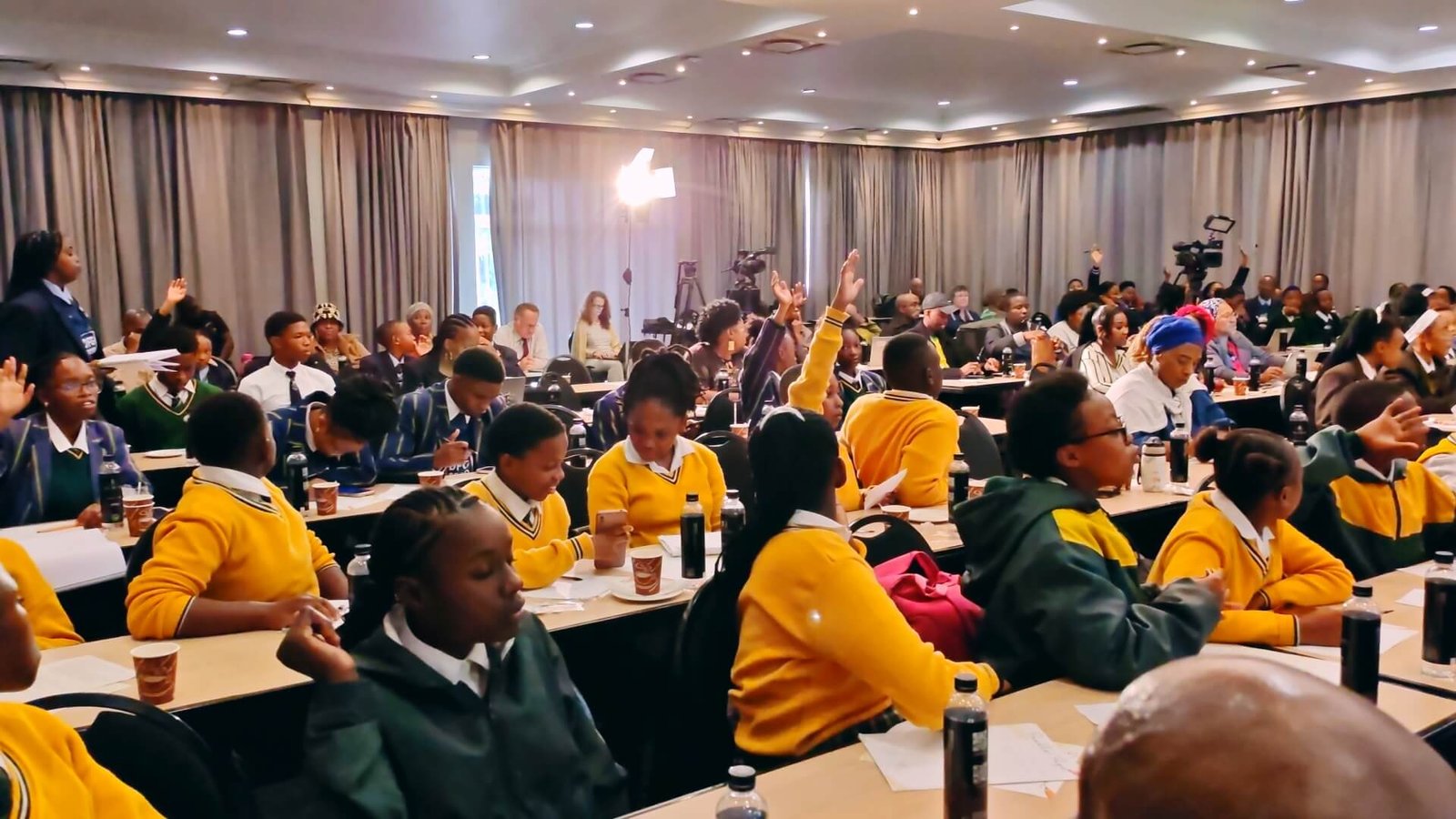
EKURHULENI — School learners in Ekurhuleni did not hold back during a stakeholder engagement unpacking South Africa’s National Drug Master Plan (NDMP), confronting officials with blunt questions about drugs in schools, whistleblower protection and whether the government is truly ready to respond.
Their concerns echo a wider national alarm over the growing availability of illicit substances in and around schools — an issue authorities and communities increasingly describe as both a public health challenge and a crime prevention priority.
The session, hosted by the Central Drug Authority (CDA), formed part of follow-up engagements after the 4th CDA Biennial Summit on Substance Abuse and Illicit Trafficking, where young people were already at the centre of national dialogue on substance misuse.
At the latest engagement, learners shifted the conversation from symbolism to accountability — challenging policymakers on the reality unfolding daily on school grounds.
Watch: Dinwiddie learners questions drug availability
One learner from Dinwiddie High School posed a stark question to officials: why are drugs still so easily accessible to school learners?
“Are drugs destroying the youth, or is the government failing to protect us?” the learner asked.
Per the X thread below by NOWinSA, the question reflected growing frustration among students who acknowledge the value of existing national strategies and awareness campaigns, yet say illicit substances continue to circulate in and around schools..
The engagement brought together learners from Leondale Secondary School, Hoërskool Elspark, Hoërskool Elsburg and Dinwiddie High School — many of whom are also involved in the Drug Free Generation 2030 (DFG2030) programme, launched earlier this year to strengthen youth-led prevention efforts. (Read more: Drug Free Gen 2030 launch at Leondale)
The initiative forms part of broader school-based anti-drug interventions supported by the World Changers Candidate programme, which works with learners to promote accountability, leadership and community-driven solutions to substance abuse.
The whistleblower dilemma in schools
Among the most compelling contributions was a presentation by Rose Shai, Head Girl at Hoërskool Elspark, focusing on the barriers preventing learners from reporting drug activity at school.
“How can the schools and policing system ensure that learners can report drug use on school premises, and that the teacher they’re reporting to won’t bother not listening to them?” Shai asked.
“And that the system doesn’t take time identifying these learners — to ensure that learners now don’t feel exposed and unprotected.”
Shai highlighted the vulnerability of whistleblowers who must continue attending the same school as those they report.
“What measures are taken when the same whistleblowers and perpetrators are on school grounds?”
The remarks struck a chord among attendees, raising concerns about whether current reporting systems — if any — genuinely protect learners who come forward.
“When young people are given the opportunity to speak, when we are heard and the system responds to us, we can build safer schools and communities,” Shai added.
“So the question is not whether young people are willing to speak up — the real question is, will the system be ready?”
Why whistleblower protection is central to the drug fight
Although the National Drug Master Plan does not currently contain a dedicated chapter on whistleblower protection, officials acknowledged during the engagement that safe reporting mechanisms are essential if communities — particularly schools — are to play a meaningful role in combating drug activity.
Delegates indicated that the concerns raised by learners would be formally recorded and considered in future policy refinements.
The issue is not new. In previous parliamentary briefings, the Central Drug Authority (CDA) has highlighted that the lack of protection for individuals reporting drug crimes remains a major barrier undermining the effectiveness of South Africa’s national anti-drug strategy.
Under the NDMP framework, the CDA acts as the central coordinating body mandated by the Prevention and Treatment of Substance Abuse Act (No. 70 of 2008) to oversee implementation across 16 government departments.
The strategy focuses on several key pillars:
- Demand reduction: prevention, early intervention, and treatment
- Supply reduction: law enforcement to disrupt trafficking networks
- Identification of new psychoactive substances (NPS)
- Governance reforms: overcoming the “silo mentality” that often slows coordinated action
At the local level, the plan relies on Local Drug Action Committees (LDACs) — municipal structures designed to connect schools, police, social services, and community organisations in the fight against substance abuse.
Yet learners’ questions revealed a practical challenge: reporting drug activity becomes difficult when those who come forward fear retaliation, exposure, or lack of follow-up. This underscores the urgent need to integrate stronger whistleblower protections into the NDMP and school-level interventions, ensuring that learners and community members can safely contribute to combating substance misuse.
What stronger whistleblower protection in schools could look like
Legal experts have long highlighted that South Africa’s current framework for protecting whistle-blowers is limited, leaving individuals vulnerable to intimidation, retaliation, and other risks. According to Cliffe Dekker Hofmeyr:
“The Act in its current form offers limited protection to whistle-blowers as it leaves them vulnerable to intimidation, job insecurity and threats to their physical well-being and lives. The current framework is insufficient and confined to protecting employees without providing the necessary support. Further, the Act requires disclosures to be made through specific channels, which discourages many potential whistle-blowers from coming forward. South Africa’s existing framework falls short of international standards in terms of coverage and whistle-blower incentives.”
— Cliffe Dekker Hofmeyr, Safeguarding truth: A new look at the proposed whistleblower-protections in South Africa
Read full article
In the school context, this underscores the urgent need for measures that allow learners, teachers, and staff to safely report drug activity without fear of retaliation or exposure. Potential approaches include:
- Confidential reporting channels: Ensuring whistle-blowers can submit disclosures anonymously or through secure, protected mechanisms.
- Legal and emotional support: Providing access to legal advice and counselling to address potential threats or pressures arising from reporting.
- Clear accountability structures: Establishing responsive protocols within schools and linked authorities to act on reports efficiently.
- Family protection and safeguarding: Recognising that threats may extend beyond the individual whistle-blower to their immediate family, with measures to mitigate such risks.
By adopting these measures, schools can create an environment where young people feel empowered to raise concerns, contributing to safer educational spaces and reinforcing broader national efforts under the National Drug Master Plan.
Youth participation central to NDMP engagement
According to the CDA, the engagement was designed to create space for direct dialogue between young people and policymakers. Officials emphasised that youth voices are essential to shaping the country’s response to substance use.
The session aimed to unpack the National Drug Master Plan while strengthening prevention and community-based approaches, and to “provide learners with an opportunity to engage directly with policymakers and stakeholders”.
Drugs, unemployment and economic vulnerability
The discussion also expanded beyond school safety to include economic factors driving the drug problem. One learner questioned whether government programmes targeting semi-skilled unemployed youth are adequately funded and effective.
“Do you think helping semi-skilled people is going to work? Do you have the funds to skill these workers to ensure they get empowerment?” the learner asked.
“As you know, no business wants to employ unskilled people.”
The comment underscored a growing awareness among young people that substance abuse is closely tied to broader socio-economic pressures.
For NOWinSA, which has long reported on the growing drug crisis affecting young people and schools, the exchange highlighted a clear shift: learners are no longer simply the targets of prevention campaigns — they are emerging as active participants demanding accountability and practical solutions.
(See coverage: World Drug Day concerns after tavern tragedy)
Throughout the engagement, learners returned to the same underlying concern — that strategies and policies will only matter if those affected by drugs on the ground feel safe enough to report what they see.
As the dialogue ended, one question lingered — posed by a learner but directed squarely at the country’s leadership:
If young people are ready to speak up, will the system be ready to protect them — and act?