

By Mosa Cibi
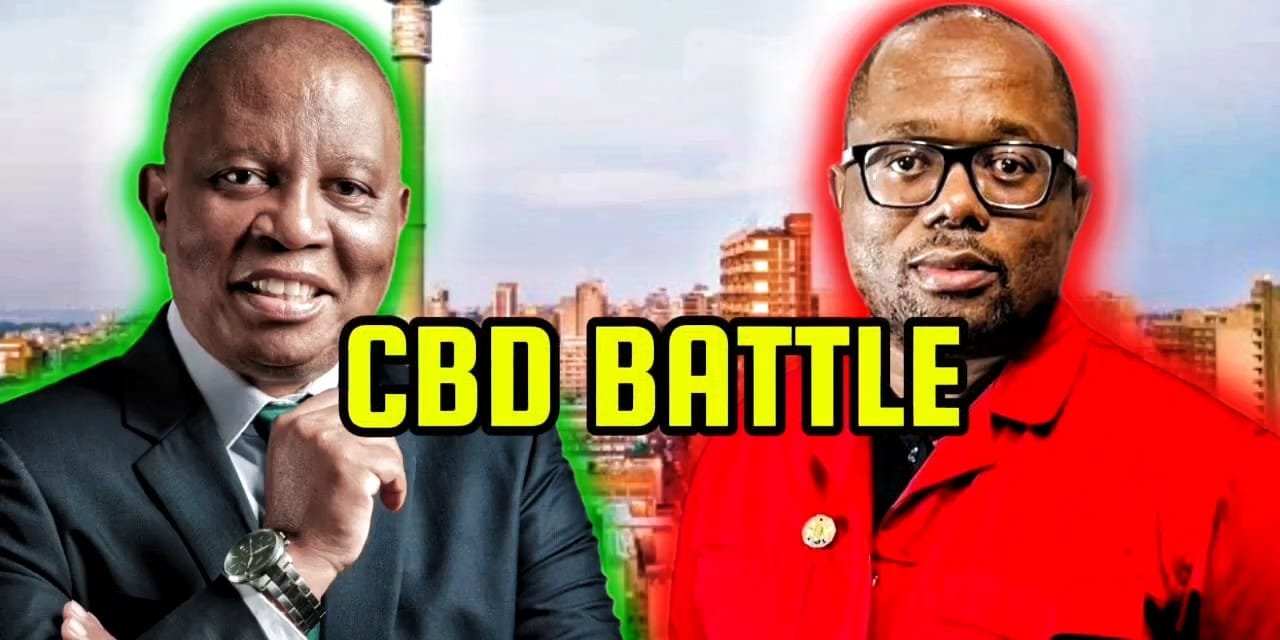
JOHANNESBURG — Joburg inner city stands at a historic crossroads — caught between its legacy as Africa’s economic engine and its present reality of abandoned, hijacked and increasingly dangerous “dark buildings.” As the crisis deepens, the political debate over how to fix the CBD has hardened into two sharply opposing visions, each offering a radically different future for the city’s heart.
On one side is Herman Mashaba’s ActionSA, which promotes a private-sector-led revitalisation model, arguing that market efficiency and private capital are the only realistic tools capable of restoring Johannesburg’s decaying skyline. On the other is Mgcini Tshwaku, the City of Johannesburg’s MMC for Public Safety and an EFF deployee, who is advancing a far more radical alternative: the expropriation of hijacked buildings to be held as public assets, ensuring the CBD remains owned, occupied and shaped by South Africans themselves.
Tshwaku’s approach is closely aligned with the EFF’s broader campaign ethos around state-led intervention, redistribution and reclaiming public wealth, as outlined in the party’s wider economic framework and fiscal demands.
The gentrification risk: ActionSA’s market-first approach
Critics of the ActionSA model warn that Johannesburg risks repeating a familiar South African mistake — “Cape Town-style gentrification.” By transferring large swathes of inner-city property to private developers, they argue, affordability becomes a slogan rather than a lived reality.
Private capital, by design, prioritises return on investment. That often translates into rising rentals, exclusionary developments and the displacement of working-class residents — a pattern already visible in several gentrified urban hubs nationwide.
ActionSA’s vision also unfolds within a volatile political landscape. Speculation about Helen Zille’s possible influence on Johannesburg’s future leadership underscores how contested the city’s direction remains.
(See: Helen Zille in the running — Joburg’s future mayor?)
This instability was further exposed during the tenure of former mayor Kabelo Gwamanda, whose administration became mired in controversy, reinforcing public scepticism around elite-driven “turnaround” promises.
(Background: Former Joburg mayor Kabelo Gwamanda accused of funeral scam).
Democratizing Ownership: Keeping Wealth in South African Hands
Where Mashaba’s vision centres on billionaires and major property groups, Tshwaku’s proposal seeks to democratise ownership itself.
Under this model, reclaimed buildings would be converted into micro-investment opportunities, similar in principle to platforms like EasyEquities. Instead of entire blocks being owned by a handful of corporations, ownership would be fragmented among thousands of ordinary South Africans.
A nurse, security guard or street vendor could buy digital “shares” in a refurbished building — earning dividends while directly benefiting from the city’s recovery.
- Keeping profits local: Unlike private-led developments where revenue often flows into corporate reserves, this model ensures returns circulate back into South African households.
- A national asset: By giving South Africans first access to ownership, the CBD becomes a shared national resource rather than a speculative property portfolio.
The State’s Mandate — and the expropriation question
ActionSA frequently argues that the state lacks the capacity to manage large-scale urban renewal, making private-sector intervention unavoidable. Tshwaku rejects this framing, describing it as an abdication of the state’s constitutional duty to provide housing, safety and dignity.
By invoking the Expropriation Act, the city could reclaim abandoned or hijacked buildings at a fraction of the cost faced by private developers.
Saving from these acquisition can be redirected toward high-quality renovations. Crucially, the EFF model ensures that the inner city is inhabited by South Africans, turning “dark buildings” into safe, productive hubs—such as student accommodation and small business centers—where the government acts as the guarantor of stability for its citizens.
Law enforcement and reclaiming the CBD
Crucially, Tshwaku’s approach is not purely ideological. As documented in the viral NOWinSA X post below, with NOWinSA present during multiple operations, he has been a central figure in several high-impact multi-agency raids across the Johannesburg CBD, targeting drug syndicates, organised crime networks and illegal occupations.
(Report: Chaos erupts as multi-agency raid targets drugs, crime networks and illegal immigrants).
These operations form part of a broader push to reclaim Johannesburg from decay and drug infiltration, with law enforcement confronting the criminal ecosystems that have flourished inside hijacked buildings.
Reclaiming the commons
At its core, this debate is about ownership — and belonging.
ActionSA envisions a city made attractive to business as a condition for survival. The EFF, through Tshwaku’s public safety and urban renewal portfolio, envisions a city reclaimed as a public good, centred on the people whose labour built Johannesburg in the first place.
Reclaiming hijacked buildings presents a once-in-a-generation opportunity to undo historic spatial injustice. By combining the legal power of expropriation with a modern, inclusive investment model, Johannesburg’s inner city could once again become a place of safety, opportunity and shared prosperity.
The question confronting voters and policymakers alike is simple — but profound: who should Johannesburg belong to?