

South Africa’s Justice, Crime Prevention and Security Cluster has issued a stark warning: hiring or accommodating undocumented foreign nationals is a criminal offense.
Under the Immigration Act (No. 13 of 2002), is it illegal to employ foreigners who are undocumented, hold invalid work permits, or work in roles that contradict their visa conditions.
Anyone found “aiding, abetting, assisting, enabling or in any manner helping” an illegal foreign national will face severe penalties, including fines and even imprisonment of up to one year for first-time offfenders.
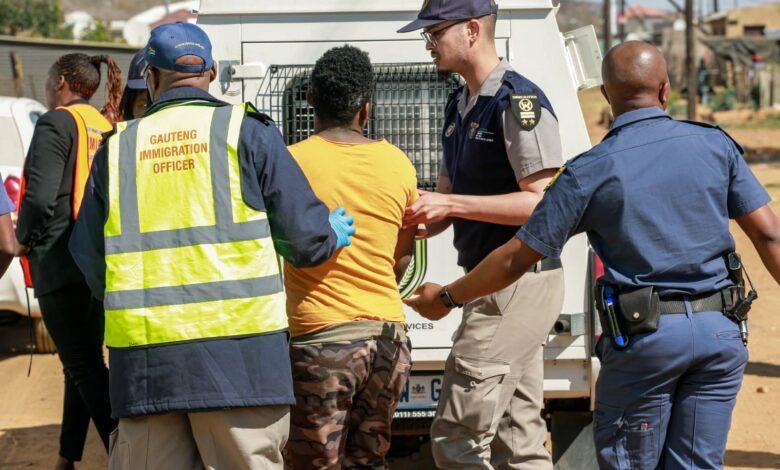
The announcement comes on the back of a sweeping national crackdown known as Operation New Broom, a nation-wide inforcement initiative launched this week by the Justice, Crime Prevention and Security (JCPS) Cluster. Led by the Department of Home Affairs, the Cluster also comprises key government agencies, including the South African Police Service (SAPS) and Correrectional Services.
This strategically coordinated push aligns with President Cyril Ramaphosa’s illegal hiring crackdown measures, signalling a broader government-wide escalation.
Under this non-nonsense approach, authorities are deploying the Automated Biometric Identification System (ABIS), among other high-tech tools, to verify immigration status, reduce document fraud, and build stronger legal cases. Authorities are also holding so-called “enablers” — employers and landlords — both legally and financially accountable.
Employers, property owners, and administrators are legally obligated to verify the immigration status of foreign nationals before offering employment or accommodation.
Enforcement ramps up on the ground as arrests and deportations rise
After sharing a descritive video as the operation unfolded on Thursday, the Minister of Home Affairs Leon Schreiber said: “Before daybreak this morning, I was on the ground as Operation New Broom swept through Sandton, Johannesburg, arresting dozens of illegal immigrants for deportation. We continue to scale up enforcement, including through the use of drones and biometrics, to restore rule of law “
He also shared statistics highlighting the programme’s success a year after its initial 2025 launch under the Government of Nation Unity (GNU). Through the programme, the Department of Home Affairs has carried out 109,344 inland deportations — excluding direct deportations by the Border Management Authority (BMA).
According to the Department of Home Affairs, 109,344 undocumented immigrants were deported over the past two financial years, marking a 46% increase:
- 39,672 deportations in 2023/24
- 51,560 in 2024/25 (up 30%)
- 57,784 in 2025/26 (up a further 12%)
Minister Schreiber said the figures reflect “intensified enforcement and improved efficiency”. He attributed this to highly-coordinated biometric verification systems and new surveillance technologies, including drones and body cameras.
Before the midpoint of the crackdown, tensions around enforcement had already reached fever pitch, as seen in previous Johannesburg inner-city crackradown, notably those involving the Economic Freedom Fighters (EFF), highlighting the complex legal and humanitarian dimensions of immigration control.
“These numbers show that we are now reaping the fruits of reforms focused on greater efficiency and intensified enforcement against immigration violators,” he said, adding: “Our message remains clear: If you are in South Africa illegally, self-deport now before we find you and ban you from ever entering our country legally in future.”
Coordinated escalation across government
Here is your fully integrated and refined section, with smooth flow, corrected grammar, and proper link embedding — keeping your tone and structure intact:
Coordinated escalation across government
The operation is not isolated and comes just months after President Cyril Ramaphosa outlined a broader enforcement push targeting the hiring of undocumented foreign nationals, signalling a coordinated escalation across government.
In parallel, enforcement is also tightening around unlawful housing conditions. Authorities have pointed to incidents like the Johannesburg illegal building collapse investigation as evidence of the risks tied to unregulated accommodation and property networks.
As seen in recent months, authorities are also scaling up border enforcement alongside inland operations. Military-led operations across Southern Africa, working in coordination with the SANDF, have intercepted more than 1,000 undocumented foreign nationals at the Groblersbridge border in December 2025 while attempting to cross illegally into Zimbabwe via Botswana.
In a separate incident underscoring growing concerns, the Border Management Authority (BMA), working closely with the SANDF, intercepted more than 20 minors near the Limpopo River in the vicinity of the Beitbridge border fence. The children, aged between 5 and 17, were believed to be travelling from South Africa to Zimbabwe during routine border safeguarding operations.
Authorities reported that the group included 10 adults; however, preliminary verification confirmed that only one adult was the parent of a child. The remaining minors were travelling without parental supervision or lawful guardianship.
The Border Management Authority has deployed drones, amphibious vehicles, and biometric systems at key crossings, reporting a deterrent effect on illegal crossings.
Dire consequences of hiring or housing undocumented migrants
The Justice Cluster stressed:
- Employers must ensure foreign nationals hold valid work visas tied to their employment
- Landlords must verify legal residency documents before renting property
- Only scarce or critical skills may justify foreign employment under the law
Those who fail to comply face criminal persecution. Courts may impose substantial fines and/or imprisonment, while enforcement operations often result in the arrest and deportation of undocumented individuals.
The government has also urged the public to report corruption and violations, warning that anyone who facilitates illegal immigration — whether through profit or negligence — will be held accountable under the law.
Immigration numbers in South Africa
Official and research-based estimates provide a clearer picture of migration in South Africa:
- Total foreign-born population: Approximately over 3.09 million immigrants (latest StatsSA Report )
- Share of population: Around 4.8% to 6.5%
- Undocumented migrants: Estimated between 500,000 and 1 million
- Largest groups: Zimbabwe, Mozambique, and Lesotho nationals
Statistics South Africa data show that the number of foreign-born residents has steadily increased over the past decade. However, the scale of undocumented migration remains difficult to quantify due to its irregular nature.
New immigration law reforms underway
The government is also moving to tighten the legal framework. The Immigration Amendment Bill, 2024, aims to address constitutional gaps identified by the courts, particularly around detention and deportation procedures.
Authorities expect the reforms to strengthen enforcement powers while aligning immigration law with constitutional protections — a balance they say is critical as enforcement ramps up.
For a deeper legal breakdown, see new developments regarding the Immigration Amendment Bill.