

The global battle over AI music, artist rights and copyright has reached South Africa.
Last week, The Atlantic launched its searchable AI Watchdog database, allowing musicians, rights holders and fans to discover whether songs associated with particular artists appear in four publicly documented collections containing more than 21 million tracks.
The project forms part of The Atlantic’s ongoing investigation into books, videos, music and other media shared within the artificial intelligence ecosystem.
Researchers behind the initiative caution that a song appearing in a collection does not prove it was ultimately used to train an AI model.
Its presence also does not establish copyright infringement, licensing arrangements or ownership rights.
Yet the database has transformed the debate around generative AI music.
For many musicians, it offers the first opportunity to see whether years of creative work may have entered repositories assembled for the development of AI-powered music systems.
What we know about AI music and South African artists
- More than 21 million songs appear in AI music collections globally
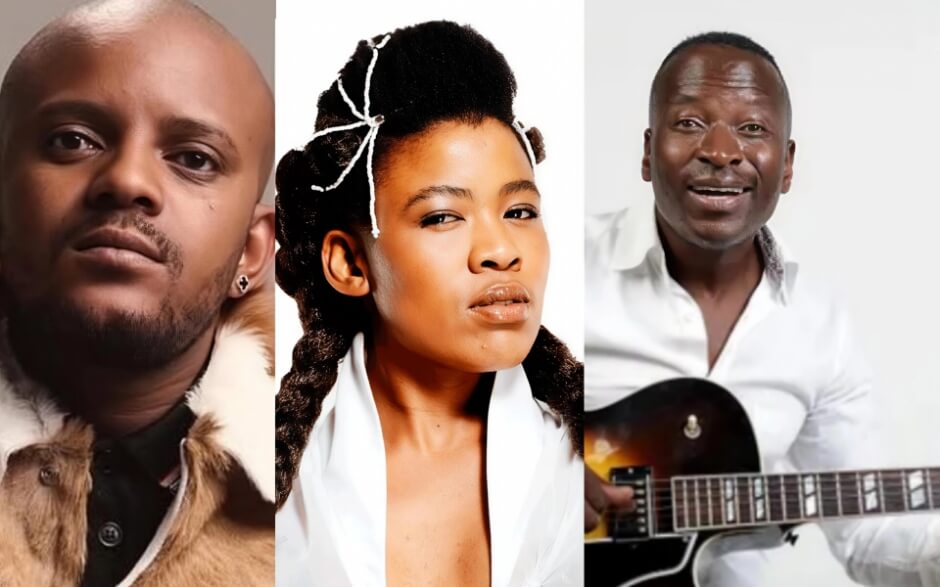
- South African artists including Kabza de Small, DJ Maphorisa and Brenda Fassie appear in these datasets
- Artists appearing in collections does not prove copyright infringement
- The global debate has intensified following SZA’s public criticism
SZA leads growing backlash over AI music and copyright
International concern intensified after Grammy-winning singer SZA discovered that 238 songs linked to her catalogue appeared in the collections.
In a series of Instagram posts, she questioned whether some of the songs could even be unreleased material.
“If you’re a musician and you support this degenerate shit? You’re disgusting and there’s NOTHING YOU COULD EVER SAY TO ME TO MAKE THIS OKAY.”
SZA also argued that Black musicians have become particularly vulnerable as AI companies seek out sounds that shape global popular culture.
Her comments followed controversial remarks made by producer Diplo earlier this year.
“If you are a creative you need to adapt or just like give up and become an uber driver until everyone has a waymo,” he wrote on X.
Diplo later denied claims that he has equity in AI music platform Suno, saying technology itself should not be viewed as the villain.
Others have taken a harder line.
Producer Kenneth Blume, formerly known as Kenny Beats, accused AI developers of profiting from musicians’ labour.
“I can’t imagine being proud to earn a paycheck obliterating the work and dreams of artists.”
The backlash comes as major record labels continue legal action against AI music generators Suno and Udio over allegations that copyrighted recordings were used without permission.
NOWinSA searches reveal South African artists in AI music datasets
To understand how extensively South African music features in these collections, NOWinSA conducted independent searches using The Atlantic’s AI Watchdog database.
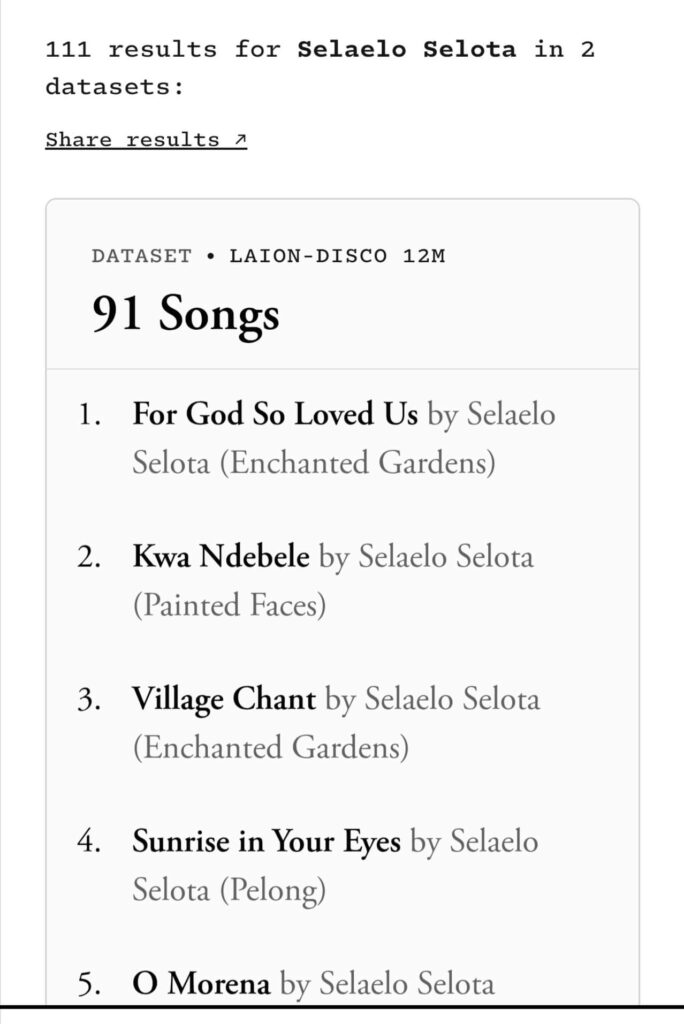
Acclaimed guitarist and composer Selaelo Selota appeared in two collections containing 111 songs.
Among the works listed were For God So Loved Us, Village Chant, Kwa Ndebele, Enchanted Gardens, Naomi’s First Dance and A Poem for Celia.
A search for Thandiswa Mazwai returned seven songs across two collections, including Revelation, Ayazizela and Lover’s Groove.
Meanwhile, Grammy winner Beyoncé appeared in five collections containing 501 songs, while Kendrick Lamar featured in seven collections with 279 songs.
The findings become even more striking when South African artists are viewed collectively.
A separate audit compiled by Cybersec Clinique identified Kabza de Small with 360 songs, DJ Maphorisa with 270 songs and Spirit of Praise with 212 songs.
The list also includes Nasty C with 193 songs, Thomas Chauke with 183, Major League DJz with 173, Brenda Fassie with 162, Cassper Nyovest with 156, Kelvin Momo with 153, Lucky Dube with 150, Hugh Masekela with 137, Sjava with 105 and DJ Tira with 91 songs.
Makhadzi appears in two collections with 135 songs, while Lira features in two collections containing 86 songs.
Interestingly, a NOWinSA search for Tyla returned no results despite her rapid international rise and Grammy recognition.
The Atlantic stresses that artists may appear multiple times within collections and that the absence of a song does not necessarily mean it was excluded from AI development processes.
How South African music and Amapiano became valuable to AI systems
The findings should not be read as a popularity contest.
Instead, they reveal how deeply South African music has travelled within digital spaces now being mined by artificial intelligence companies.
Genres such as Amapiano, gospel, jazz, Afro-soul, hip-hop and traditional music have become influential far beyond the country’s borders.
The appearance of artists such as Kabza de Small and DJ Maphorisa, whose productions helped redefine modern Amapiano, suggests that South African rhythms, vocal textures and production styles have become valuable reference points within the AI era.
At home, the conversation has intensified. As shown in the X post below, Cybersec Clinic founder and CEO Doreen Mokoena (@MokoenaDee), a data analyst, observed:
“The biggest export South Africa never authorised may be its culture.”
The post, which includes a chart of South African artists appearing in AI training datasets, has since been widely circulated — including by comedian and radio host Sol Phenduka, whose repost attracted over 500,000 views.
Another X user called on the Department of Sport, Arts and Culture and organisations such as DALRO to examine whether stronger protections are needed for musicians whose work appears in AI collections.
For now, The Atlantic’s database has transformed what was once a black box into a searchable record.
Whether that transparency results in licensing deals, lawsuits or new legislation remains uncertain.
South African musicians may not have agreed to participate in the AI revolution, but their music appears to be helping teach machines what the world increasingly sounds like.
Related Coverage: Shebeshxt arrested amid packed festive tour dates