


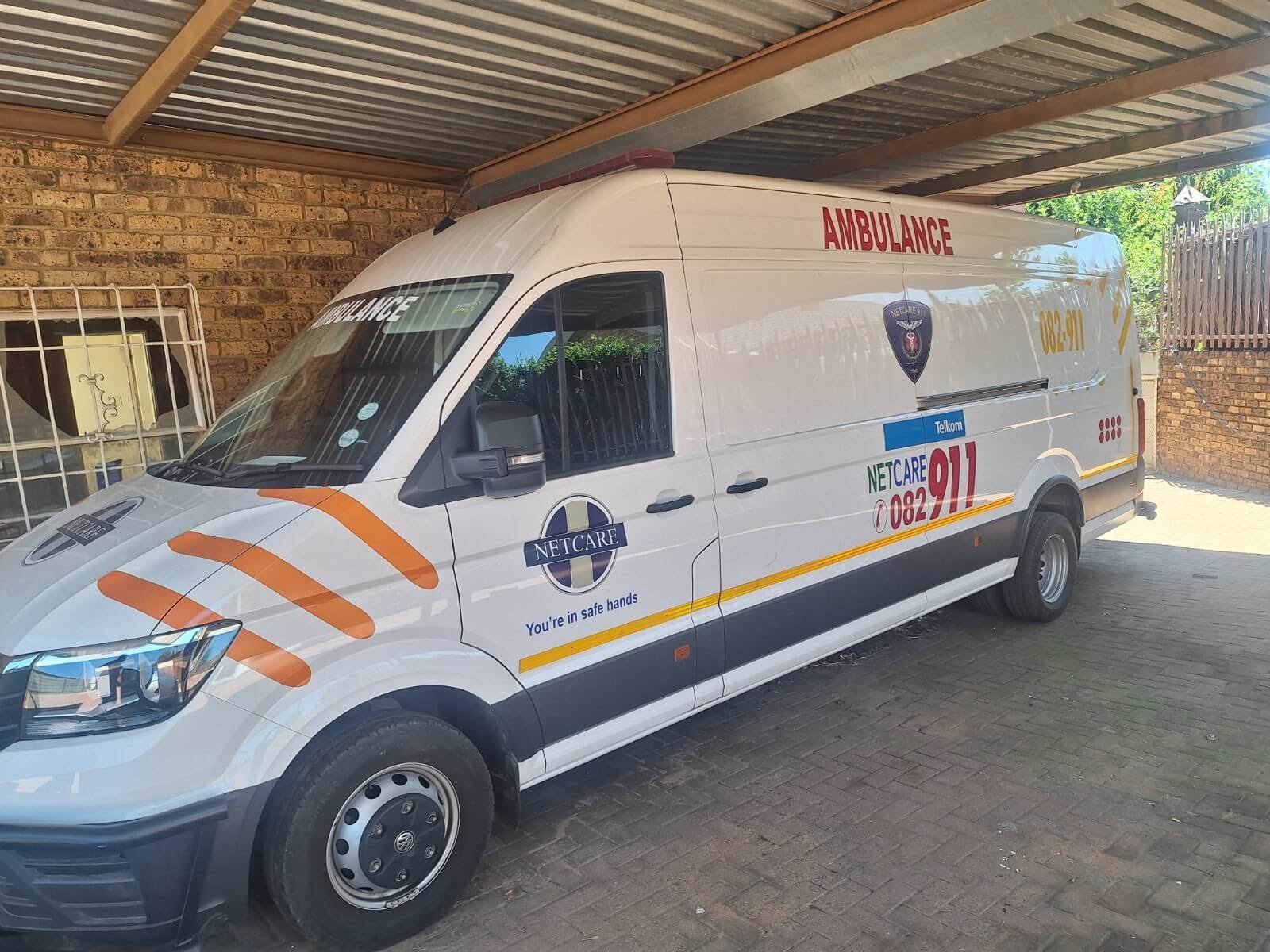
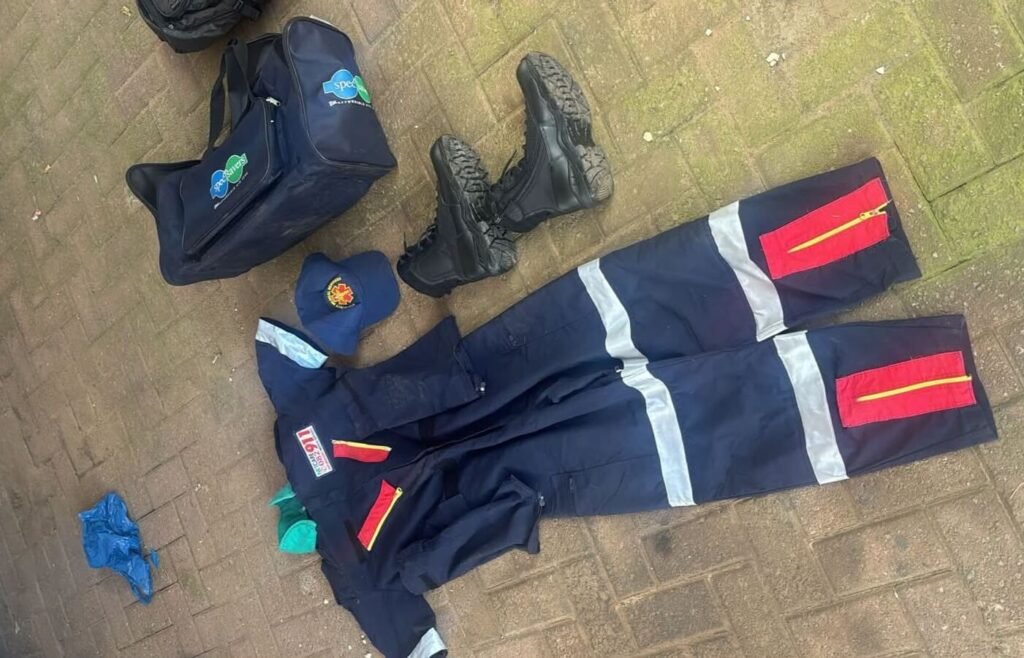
RANDFONTEIN — South African Police Service (SAPS) investigators have uncovered a cloned ambulance and emergency service uniforms hidden in the yard of a residential property in Randfontein on Gauteng’s West Rand, intensifying fears around the growing use of fake emergency vehicles to commit serious crimes.
The discovery followed an intelligence-driven tip-off that led officers to the property, where they found a vehicle carefully disguised to resemble a legitimate Emergency Medical Services (EMS) ambulance. Alongside it was a stash of uniforms that police believe may have been used to impersonate first responders.
Crime reporter Yusuf Abramjee, who shared footage of the raid on social media, said police suspect the vehicle was used in the commission of crimes, with investigations now under way to determine exactly where and how it was deployed.
The homeowner, described as an elderly man, told police he had simply rented out space in his yard and claimed he was unaware of the nature of the vehicle or its alleged use. The individual who parked the ambulance there is now being traced.
A dangerous escalation in criminal tactics
Security analysts say the use of a cloned ambulance represents a troubling escalation in how syndicates exploit public trust.
“An ambulance is the perfect disguise,” said one security expert. “Motorists automatically yield, roadblocks are less likely to question it, and its presence near a crime scene rarely raises suspicion.”
Unlike cloned police sedans, ambulances provide both credibility and capacity — space to transport weapons, stolen cash, or signal-jamming equipment. Investigators believe such vehicles are increasingly attractive for crimes such as cash-in-transit heists, kidnappings, and targeted robberies, particularly in areas already grappling with organised crime and hijacked buildings. This mirrors concerns raised in reporting on how hijacked buildings are linked to violent syndicate crime on the West Rand.
A familiar pattern: Not the first cloned emergency vehicle
While shocking, the Randfontein case is not unprecedented.
In 2024, police uncovered a cloned SAPS vehicle and police equipment at a property in Walkerville, south of Johannesburg. That incident, documented in an Arrive Alive report on a cloned police vehicle and equipment found in Walkerville, revealed how criminals were already replicating official patrol cars to commit crimes while evading suspicion.
At the time, road safety experts warned that blue-light impersonation had shifted from isolated incidents to organised, methodical operations. The Randfontein ambulance suggests that tactic has since evolved further, moving from police sedans to emergency medical vehicles that command even greater public trust.
Echoes of the Cat Matlala blue-light saga
The seizure has also revived public unease around the wider blue-light controversy associated with Vusimuzi “Cat” Matlala, whose name has become synonymous with allegations of unlawful blue-light use and institutional compromise.
Although SAPS has not linked the Randfontein ambulance directly to Matlala, the similarities are difficult to ignore. Testimony before the Madlanga Commission detailed how private vehicles were allegedly fitted with police blue lights through irregular agreements, blurring the line between state authority and private power. These revelations were central to explosive testimony heard at the Madlanga Commission.
Matlala’s companies — including Medicare24, which secured a controversial SAPS health services tender — have also been scrutinised amid concerns that legitimate-looking emergency assets could be misused or unlawfully equipped, concerns that previously led to his secret transfer to maximum security amid safety and bribery fears.
“The fear is that criminals watched how authority could be mimicked, tolerated, or even protected — and then copied the model,” said a source close to the investigation.
How to identify legitimate emergency vehicles
SAPS has published clear guidance on how to identify authorised blue lights and legitimate emergency vehicles, including approved light configurations, standardised branding, and registration formats.
Common warning signs of cloned vehicles include poor-quality decals, inconsistent fonts, non-standard number plates, or the use of outdated magnetic lights rather than integrated light bars.
What to do if you feel unsafe
If you are signalled to pull over by a vehicle displaying blue or red lights and feel uneasy, authorities advise motorists to follow a safety-first protocol:
- Do not panic or speed away. Switch on hazard lights and slow down to indicate compliance.
- Signal for the vehicle to follow you rather than stopping immediately.
- Proceed to a police station or a busy, well-lit public place, such as a petrol station.
- Call 10111 while driving and ask for verification of the vehicle behind you.
- Only stop once you are in a secure location and legitimacy has been confirmed.
Understanding and applying these steps is as critical to public safety as knowing official evacuation procedures during wildfire emergencies.
Investigation continues
Forensic teams are now examining the cloned ambulance for fingerprints, DNA, and vehicle identifiers as police work to establish whether it was part of a broader syndicate network.
What the Randfontein case makes clear is that South Africa’s blue-light problem is no longer confined to fake police cars. With ambulances now being cloned and weaponised for crime, the line between rescuer and threat has never been more dangerously blurred.
A follow-up report will detail the official protocol motorists should follow if they suspect an emergency vehicle or officer is not legitimate.