

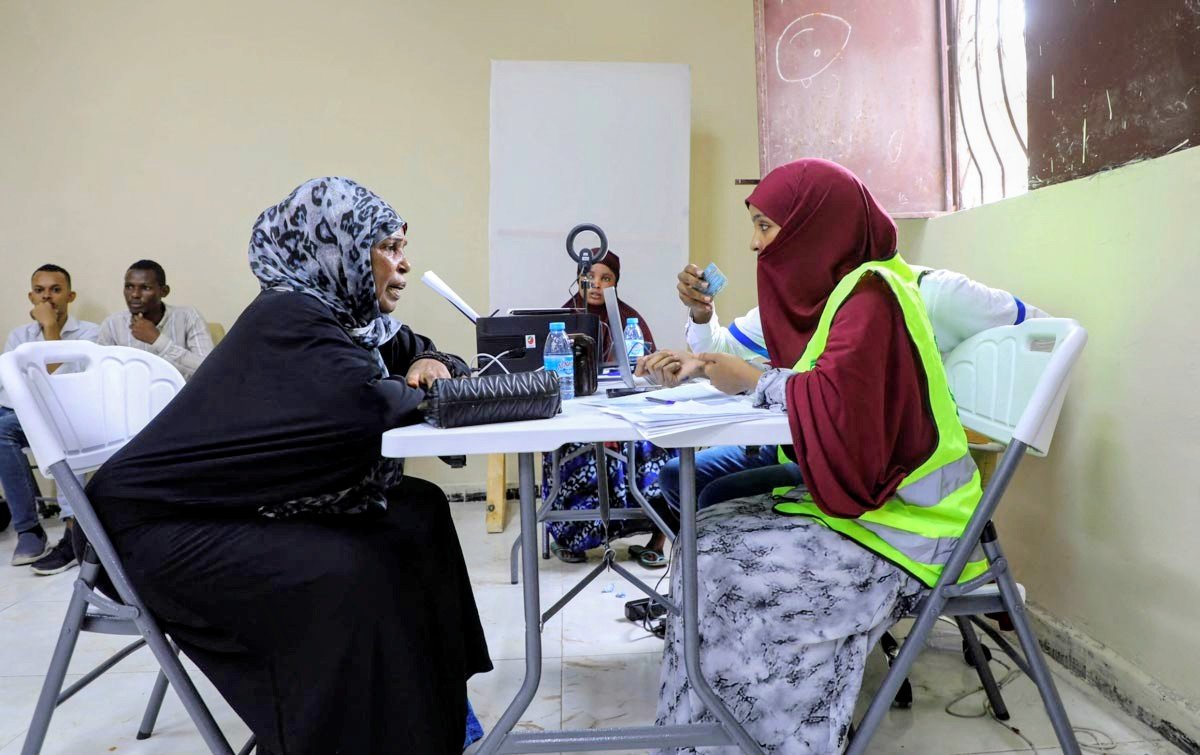
Amid mounting controversy over elections in Somalia, the National Independent Electoral and Boundaries Commission announced an official correction to the list of districts scheduled to hold local council elections across the country’s federal member states.
The commission confirmed that the amendment followed the discovery of a technical error in a previously published schedule. Registered political parties and voters can consult the official list of election locations to verify where local council elections will be held
In a statement dated February 24, 2026, it said it was “sharing with the Somali people and all political organizations the correct list of districts that will witness local council elections.” It noted that “a technical error occurred during the preparation of the list, leading to the inclusion of a district in which elections had already been held.”
It clarified that the district had been mistakenly included among those slated for upcoming elections, despite the fact that its local council elections had already taken place on May 25, 2023.
The commission offered its apology for the error and affirmed its “continued efforts to ensure an accurate and credible electoral process that strengthens the confidence of citizens and political actors alike.”
In a separate context, it announced the completion of all technical and administrative arrangements for local elections in several regional states. It called on “registered political parties to adhere to the established timetable and to formally commence participation procedures and the submission of candidate lists.”
It stated that preparations had been finalized in the states of South West, Hirshabelle, and Galmudug, in addition to the northeastern regions (Khatumo/Sool, Sanaag, and Ayn). The process, it emphasized, would proceed in accordance with the laws, regulations, and directives governing elections in the country.
Obstacles in the Process
For more than half a century, local elections have not been held in Somalia. Authorities in Mogadishu postponed them last November following a decision taken at the request of 61 political associations representing more than 900,000 registered voters in the capital, according to the electoral commission.
Talk of direct elections is not a political luxury but a historical necessity, according to Abdulrahman Sahal Yusuf, who stated that “defending freedom in the Somali context means defending the citizen’s right to choose his leadership personally, without intermediaries, and to grant it a mandate through a transparent and fair process.”
He added that “the present moment demands clarity in alignment: either siding with a future in which decisions are shaped by the will of the people, or remaining trapped in narrow calculations.” He continued: “Somalia stands before a historic opportunity to entrench a solid democratic path. The true wager is not merely on holding direct elections, but on establishing a new political culture that believes the source of authority is the people, and that the final word must belong to their free voice. When this principle prevails, the state prevails, opening the door to deeper stability and more enduring development.”
Stalling
Observers cite delays in the electoral agenda—both regional and presidential elections—amid ongoing disagreements over the nature of the forthcoming vote. Some advocate holding direct elections for the first time in decades, while others insist on returning to the indirect model based on the selection of lawmakers by clan elders.
The Somali government has announced its intention to transition to direct elections by 2026. The opposition, however, questions the readiness of the infrastructure and security environment, viewing the proposal as an attempt to circumvent the principles of transparency and pluralism.
Somalia has been experiencing political deadlock since President Hassan Sheikh Mohamud approved legislation through parliament—such as the Election Law, the Law on the Electoral and Boundaries Commission, and the Political Parties Law—seen as serving his interests and aimed at narrowing political space for his rivals.
These legislative measures include extending the presidential term to five years instead of four and expanding executive powers to allow the president to appoint and dismiss the prime minister and ministers without parliamentary approval.
The legislation has met with rejection. The government of Puntland announced its withdrawal from the federal system, stressing the necessity of a popular referendum on any constitutional amendments.
The government of Jubaland has also joined the opposition front, expressing concerns over the repercussions of the sudden implementation of a direct voting system and the extension of the president’s term.
A Difficult Reality
The political system suffers from multiple manifestations of structural fragility, exacerbated recently by the deep dispute over the electoral system—responsibility for which observers largely attribute to the president.
Somalia, according to former Somali diplomat Hussein Abdulrahman Hassan, is not merely facing a crisis of constitutional amendments but is living through a systematic constitutional capture that has hollowed out the document’s substance and transformed it into a tool for reproducing power rather than building the state.
“With the continuation of this approach, talk of political stability or a safe democratic transition remains a deferred illusion,” he said. “Exiting this impasse does not begin with unilateral amendments, but with rebuilding the constitutional path from its roots through comprehensive national consensus, completing the constitution, and establishing independent constitutional institutions before the crisis becomes a reality that is difficult to dismantle.”
He pointed out that criticism of the amendments relates not only to their substance but to the manner in which they were passed—absent national consensus and in explicit disregard of objections from pivotal states, foremost among them Puntland. “Instead of being a corrective step restoring the constitution’s consensual character, these amendments—affecting four key chapters—represented a clear attempt to reengineer the political system in a way that concentrates power in the president’s hands and undermines the essence of federalism upon which the Somali state was founded after the transitional period.”
He further noted that “continuing to operate under an incomplete constitution that has not been subjected to a popular referendum has created a deliberate constitutional vacuum used to expand executive authority at the expense of the separation of powers and the federal balance.”
In this context, Somali Federal Parliament member Abdulrahman Abdishakur said Somalia is passing through “a pivotal moment in its modern history, as security, political, and economic challenges intensify in a manner that threatens the stability of the fragile state—caught between the hammer of the terrorist movement Al-Shabaab, which is expanding its influence, and the anvil of governance failures under President Hassan Sheikh Mohamud.”
He added that the president lacks “a unifying vision and leadership sense, as his administration has become a model of narrow central governance reliant on a closed circle of advisers detached from the realities of Somali society.” Worse still, he said, is his failure to unify the national front and lead the nation toward higher objectives. “Instead of the state serving as an umbrella for all, and the president as a bridge linking the regions, the central government, and the international community, he has become a source of division and social tension due to his unilateral decisions, such as the controversial constitutional amendments and his disregard for opposition demands.”
He continued: “Entrenched corruption continues to erode public trust in the government, undermine moral values, and impede effective governance. Regrettably, our principal institutions—including the security institutions—are afflicted by embezzlement, nepotism, and abuse of power, to the point that state institutions have become instruments of patronage.”
For more context on regional instability, see Sudan’s ongoing conflict and its regional effects.