


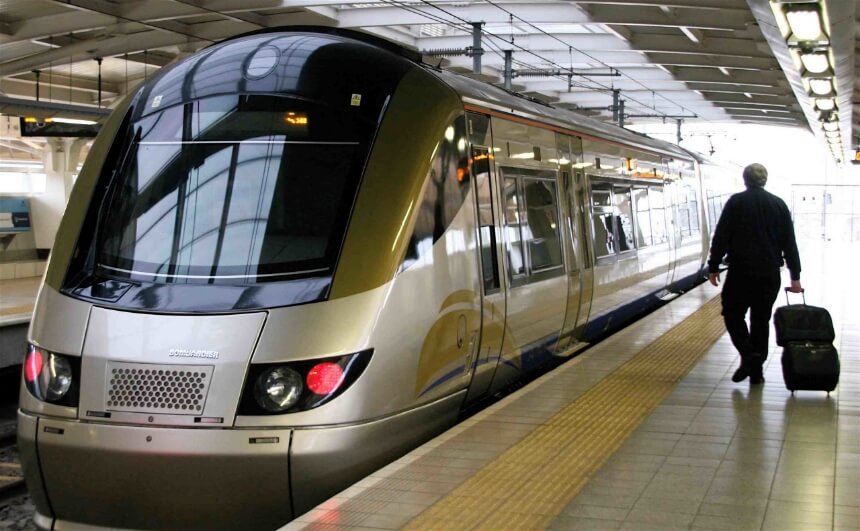
- Gautrain launches its own e-hailing service, Gau Express, set to go live in October 2026
- The service solves the “first and last mile” gap — getting commuters to and from Gautrain stations
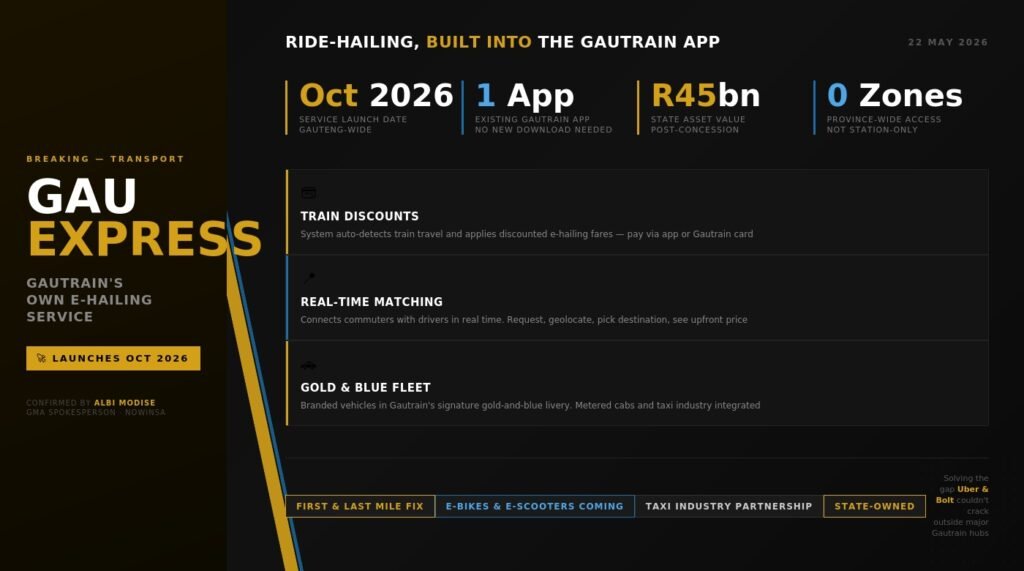
- Gau Express integrates directly into the existing Gautrain app — no new app needed
- Gautrain cardholders get discounted fares — the system automatically detects train travel
- Riders can pay via app or Gautrain card
- Vehicles will carry Gautrain’s signature gold-and-blue branding
- The service will also partner with metered cabs and the taxi industry
- Future phases aim to add e-bikes, e-scooters and electric vehicles
- NOWinSA spoke directly to spokesperson Albi Modise, who confirmed the announcement
- The launch comes less than two months after Gautrain transitioned to full provincial government ownership
The Gautrain Management Agency (GMA) confirmed the launch on Friday, May 22, 2026, through an official media release — and NOWinSA reached out directly to GMA Senior Executive Manager for Communication and Marketing, Albi Modise, who confirmed the announcement and expanded on what the service means for customers.
“Our customers are all about convenience,” Modise told NOWinSA.
“We are dealing with busy customers — on the go, travelling from one point to the other, needing convenient services. The last thing they need after a long trip or a busy day of travel is to depend on external services that may add stress to their already packed schedules.”
That thinking sits at the centre of Gau Express — a direct response to one of public transport’s biggest frustrations: getting to and from the station itself.
What is Gau Express?
Gau Express is Gautrain’s own on-demand e-hailing service built to solve what the transport industry calls the “first and last mile” problem — the gap between a passenger’s front door and the nearest Gautrain station, and the gap between the station and their final destination.
The GMA describes it as “a mobile application-based service that connects commuters with drivers in real time”, forming part of Gautrain’s broader innovation and mobility integration strategy.
Importantly, the service will not require a separate app. Gau Express plugs directly into the existing Gautrain mobile application, allowing users to request a ride, share their location, select a pickup point and destination, and receive an upfront fare estimate — all within the same platform they already use to manage Gautrain travel.
GMA CEO Tshepo Kgobe said the agency deliberately avoided launching another standalone app.
“We did not want to overwhelm customers with too many apps,” he said.
Discounts for Gautrain passengers — and payment through your Gautrain card
One of Gau Express’ standout features is its loyalty-linked pricing model.
The platform will automatically detect whether a commuter travelled on Gautrain and apply a discounted e-hailing fare — similar to how the existing Gaubus service rewards Gautrain cardholders.
Passengers will also be able to pay directly through the app or use funds loaded onto their Gautrain cards, giving commuters more flexibility without requiring a separate payment method.
Kgobe described the pricing structure as “one that empowers our trains”, reinforcing Gautrain’s intention to position Gau Express as an extension of the rail network rather than a competing standalone service.
What the vehicles will look like
Gau Express vehicles will carry Gautrain’s familiar gold-and-blue branding — featuring gold bodywork, blue lower trim and Gautrain branding on the sides, consistent with the rest of the Gautrain fleet.
The service officially launches in October 2026.
Gautrain wants to tackle safety and transport gaps
The launch of Gau Express arrives at a sensitive moment for South Africa’s e-hailing and public transport sectors.
Safety concerns involving e-hailing violence continue to affect several parts of Gauteng, particularly around informal taxi territories.
By operating under the established Gautrain brand and partnering with metered cab operators and parts of the taxi industry, Gau Express hopes to avoid some of the tensions that have disrupted Uber and Bolt services around transport hubs such as Sandton, Park Station and Hatfield.
The announcement also comes just over a year after the highly debated Afrikaans-targeted e-hailing app launch, which sparked broader public debate around accessibility, inclusion and competition in South Africa’s transport market.
Together, these developments highlight just how competitive — and politically sensitive — the country’s e-hailing industry has become.
Not just a station service
Although Gautrain designed Gau Express to improve station connectivity, Kgobe confirmed that the service will not only operate around Gautrain stations.
Commuters will be able to request rides from anywhere in Gauteng, positioning Gau Express as a full provincial e-hailing service rather than a simple shuttle extension.
The GMA also plans to expand the platform in future phases by introducing smaller electric vehicles, e-bikes and e-scooters into the ecosystem.
If successful, the expansion could position Gautrain as one of South Africa’s leading players in integrated urban mobility.
Part of a much bigger transition
The Gau Express announcement comes less than two months after a major turning point in Gautrain’s history.
On March 27, 2026, Gautrain’s original 19.5-year concession agreement with the Bombela Concession Company (BCC) officially expired. The Gauteng Provincial Government then assumed full ownership of Gautrain as a fully paid-up state asset valued between R45 billion and R50 billion.
Gau Express now stands as one of the first major customer-focused projects introduced under this new era of state ownership — signalling Gautrain’s intention to move faster on long-standing commuter challenges.
The GMA said it will continue engaging shareholders and transport stakeholders to ensure Gau Express integrates smoothly into Gauteng’s broader public transport system.
Albi Modise confirmed to NOWinSA that Gautrain will release more rollout details closer to the October 2026 launch date.