

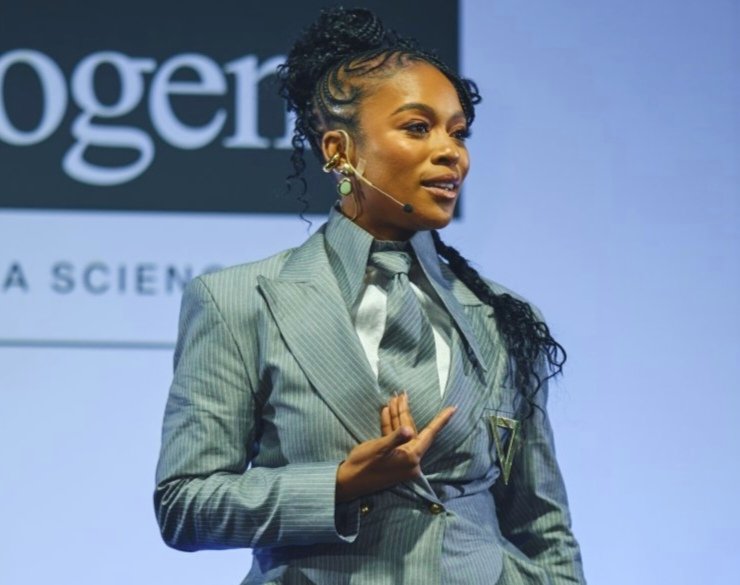
The era of unchecked skincare influencer is officially over. At a packed launch in Kramerville, Johannesburg, the Dermatology Society of South Africa (DSSA) and Neutrogena South Africa drew a definitive line between medical guidance and social media content with the launch of Skin Certified SA—the country’s first dermatologist-governed creator standard.
Actress, producer, humanitarian and longtime brand ambassador Nomzamo Mbatha hosted the evening and became the first-ever Skin Certified creator after completing the online course via the newly launched microsite. We were there, and sat down with her before the curtain fell.
The launch comes at a time when the consequences of skincare misinformation are no longer theoretical. As NOWinSA previously reported in Why your skin needs a professional therapist, not TikTok trends, misinformation-fuelled beauty advice has increasingly blurred the line between content creation and medical guidance.
How skincare misinformation became a public health risk
Africa has fewer than one dermatologist per million people across much of the continent. Into that gap, a wave of social media creators has stepped — some responsibly, many not. The results have surfaced in courts, hospitals and investigative newsrooms.
In March 2026, News24 published an investigation titled Fake doctors, Temu filler, discount Botox: How influencers sell potentially toxic beauty, exposing influencer Roxiane Anice Young for performing illegal Botox and dermal filler procedures on clients.
Under South African law, only HPCSA-registered medical doctors may administer injectable fillers. Young allegedly sourced products from discount e-commerce platforms including Temu — cheap, unapproved cosmetics linked to severe facial swelling, bruising and long-term tissue damage in clients.
The case was not isolated.
Perhaps the most striking local example remains Matthew Bongani Lani — “Dr Matthew” — who amassed more than 200,000 TikTok followers while posing as a qualified medical practitioner and Wits University graduate.
He filmed from hospital corridors, wore embroidered scrubs and carried a stethoscope in video after video. National radio stations interviewed him. SABC3 featured him. He even appeared in a since-deleted Gauteng Department of Health Youth Day campaign.
A joint DSSA and HPCSA investigation later confirmed that Lani had no medical qualifications, no matric certificate and had dropped out of high school. Authorities arrested him at Helen Joseph Hospital in late 2023 while he was still wearing scrubs and carrying a stethoscope.
As Daily Maverick reported at the time, the rise and fall of Lani “exemplifies the local tsunami of fraudsters claiming expertise that is not their own.”
Before his arrest, Lani also used his following to sell skincare products through his own e-commerce platform. His exposure left associated local brands scrambling and customers questioning the safety of treatments they had purchased based on his recommendations. He later attempted a comeback using an AI-filtered persona to promote an unregulated “Lani Skincare” range.
His story raises a question the industry has largely avoided: who carries responsibility when a creator’s advice causes harm?
What South African law says about influencer skincare advice
In South Africa, the Advertising Regulatory Board (ARB) governs transparency in influencer content. The code is clear: any commercial relationship — whether financial or through goods exchange — must be disclosed. Recognised identifiers include #Ad, #Advertisement and #Sponsored. Burying disclosures at the bottom of lengthy captions does not meet the standard.
A recent ARB ruling involving lifestyle influencer Kandy Kane and Volvo Car South Africa tested this directly. The Directorate found that even a non-cash trade exchange — in this case, use of a vehicle — constituted a material relationship requiring disclosure.
Volvo later undertook to amend the posts. The ruling now serves as a reference point for South African lifestyle, beauty and skincare influencers.
On the consumer protection side, the Consumer Protection Act prohibits false or misleading advertising claims. Influencers cannot hide behind “personal opinion” when endorsing potentially harmful products.
But globally, accountability for health-related misinformation remains difficult to enforce. A paper published in the Georgetown Law Journal and co-written by Professor Max Helveston of DePaul College of Law examined whether existing negligence laws could apply to health influencers.
Helveston argued that new legislation may not even be necessary.
“People could sue influencers for negligence,” he said. “We have seen a couple of suits, but the law just has not really had to deal with it yet.”
The challenge lies in proving causation. An injured party must show a direct link between a creator’s advice and the harm experienced — difficult in digital environments where users consume similar misinformation from multiple sources simultaneously.
Meanwhile, a 2025 research letter published in The BMJ found that influencer and corporate posts about medical tests were promotional in 87% of cases, while risks were mentioned in only 15%. Another study examining German influencers promoting supplements found that nearly two-thirds of recommended doses exceeded national safety thresholds.
The BMJ authors warned that misleading health advice can trigger “psychological, physical, financial and systemic harm”.
The editorial linked to the study concluded that “fostering trust through verified communities, clinician-endorsed forums and participatory public health campaigns will be indispensable.”
That is precisely where Skin Certified SA positions itself.
What Skin Certified SA means for responsible beauty influencers
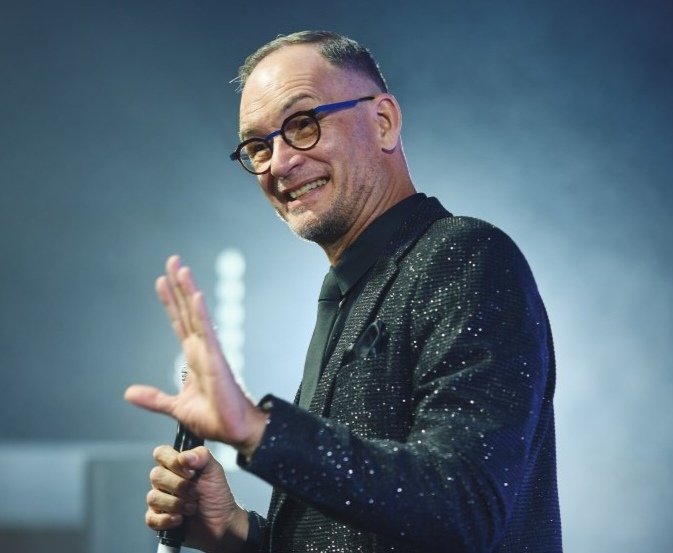
Dr Willie Visser, DSSA representative and one of the dermatologists behind the curriculum, addressed the issue directly during the launch.
“South Africans are consuming skincare content in a vacuum of misinformation,” he said.
“With fewer than one dermatologist per million people in much of Africa, we cannot rely on clinical access alone. Skin Certified SA puts credible, peer-reviewed science directly into the hands of creators — and their communities. This is a public health intervention, not a marketing campaign.”
Visser also clarified what the certification is not.
The certification does not make creators diagnosticians, authorise treatments, or amount to DSSA endorsement of individual creators or product ranges. Instead, it aims to equip creators with foundational knowledge around evidence-based skincare, ingredient safety and ethical influence.
He acknowledged that partnering with influencers would likely attract scrutiny. But Visser said the decision was deliberate: “the risks of doing nothing while beauty misinformation spreads online were greater.”
The Skin Certified SA curriculum covers skin biology, myth-busting, ethical influence and ingredient science. The course is free. Graduates receive a digital badge, a certificate and a listing on a public registry.
On the night, an AI-powered bot moved through the venue, allowing guests to interact with the course material in real time.
Importantly, Neutrogena South Africa has handed governance of the certification entirely to the DSSA. The brand’s creator network forms the inaugural cohort expected to complete the programme once the platform fully launches.
A Neutrogena spokesperson explained the thinking behind the initiative: “Better industry standards mean better outcomes for every skin. We didn’t build this to own it. We built it to prove it. Now it belongs to South Africa.”
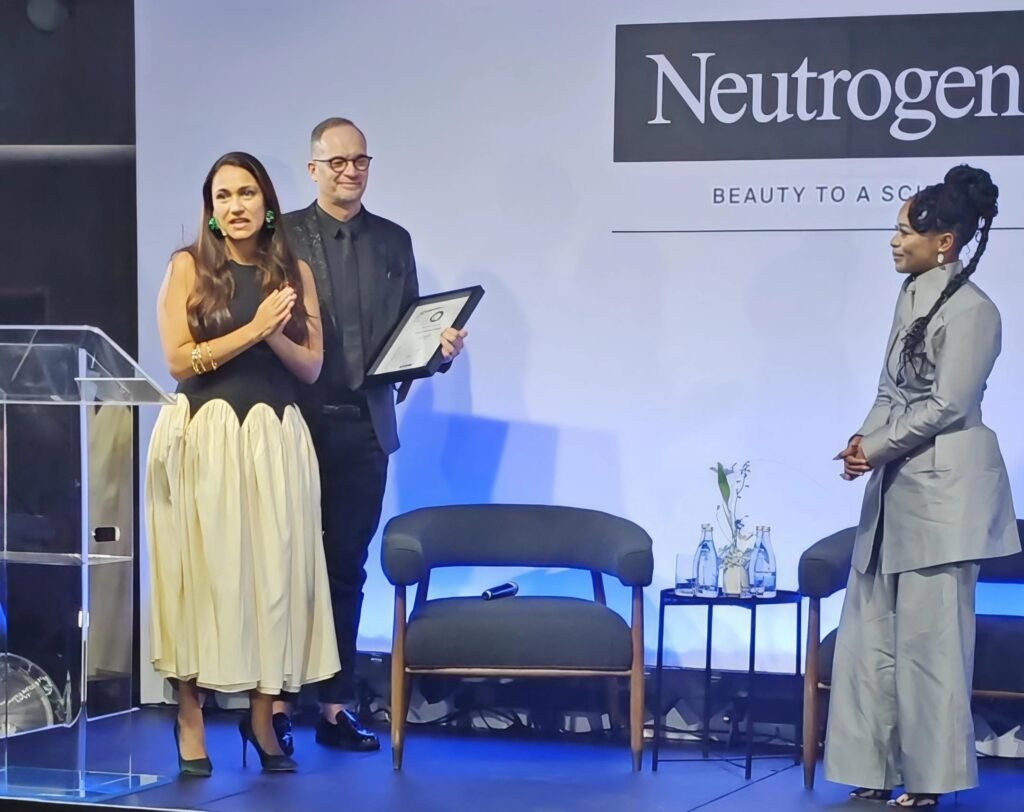
“Integrity is what leads”: our conversation with Nomzamo Mbatha
Nomzamo Mbatha has served as a Neutrogena South African ambassador since 2015 — becoming the first South African face of the global brand alongside Kerry Washington and Gabrielle Union. More than a decade later, the partnership remains intact.
She was also the first creator to complete the Skin Certified SA course.
We sat with Mbatha shortly after the programme concluded.
On why ethical messaging matters when your audience largely consists of young women, she answered immediately:
“I think it’s important because integrity is what leads, right? And it’s what I like to lead with — in the sense that there are certain products I won’t use because that’s not the product for me. I want to speak about a product that I have used and continue to use, and I can be an honest voice, an authentic voice, a real voice. So integrity is at the forefront of it.”
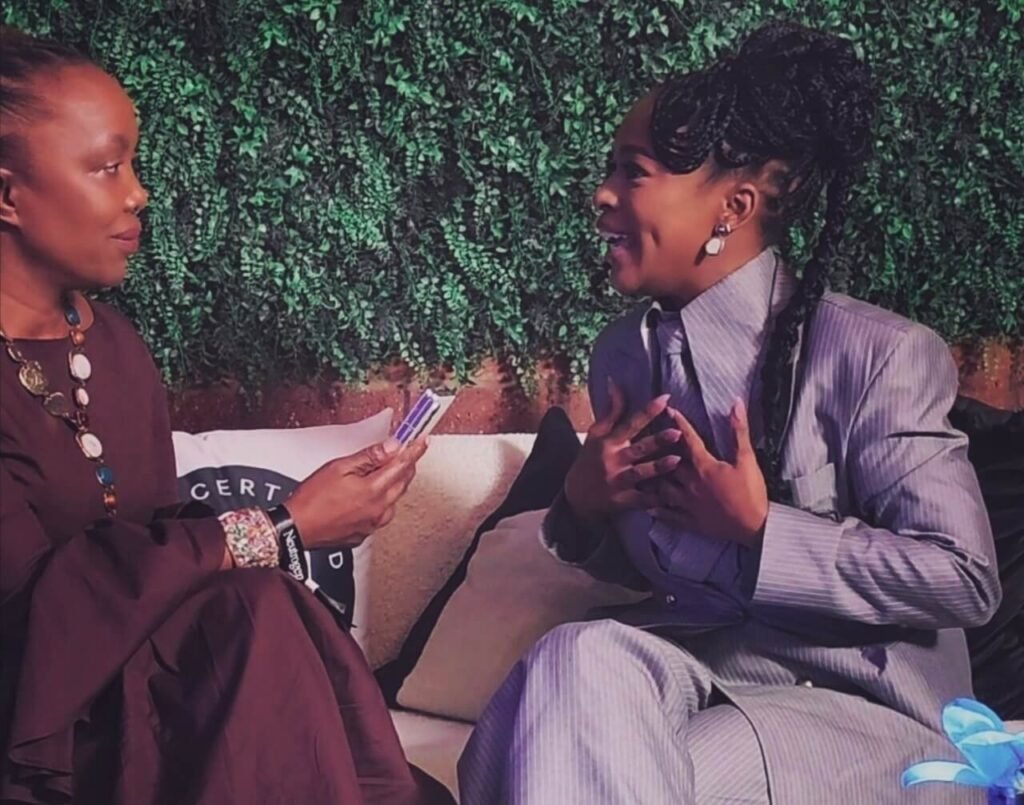
She described the purpose of the initiative as empowerment rather than gatekeeping.
“The messaging around Skin Certified is important in the sense that it’s not to gatekeep, it’s not to police, but it’s to equip. To empower. And the fact that it is available to everyone — for me, that is important.”
Mbatha also emphasised accessibility. “There are so many young women who may not be able to access education, who want to go to beauty schools, but now they have a platform that can give them a certification, and it comes from experts.”
On the role she hopes to play within the platform:
“Number one, giving it a language that translates to the everyday person and to other skinfluencers — people who are in the skincare content creation space. How do I package it in a language that is not all jargon? Because sometimes when people hear ‘science’ and they hear ‘a doctor’, they switch off.”
She paused briefly before adding: “We have 90% of their attention. So how do we use that responsibly?”
Twelve years with one global skincare brand
Mbatha’s long-standing relationship with Neutrogena is unusual in the beauty industry, where ambassador contracts often last months rather than years.
“It’s beautiful. It is honestly what I always dreamed it would be,” she said.
She recalled receiving the original call from the brand in 2014. “I still remember, I screamed when I got that call. They were like, we want a brand ambassador, and this is the girl that we want.”
For Mbatha, longevity only works when the partnership stays authentic.
“To have longevity with them means we must continue to be truthful with it. It’s an authentic relationship. But also, I am the girl next door.”
Beyond beauty: Nomzamo Mbatha’s humanitarian work
Many audiences know Nomzamo as the actress from Isibaya, the executive producer of Shaka Ilembe and the performer who appeared in Coming 2 America alongside Eddie Murphy. Fewer know the scale of her humanitarian work.
In 2019, the United Nations High Commissioner for Refugees appointed her as a global Goodwill Ambassador. Since then, she has travelled to refugee camps across Africa, advocated for displaced communities and raised funds for refugee girls and women.
Her Nomzamo Lighthouse Foundation provides scholarships for university students and supports an annual R1 million grant supporting Black women-led organisations in underserved communities.
She traces much of that purpose back to a woman she calls ARO — a mentor who funded school lunches and eventually helped a group of township teenagers travel to the UK.
“I am a beneficiary of someone who believed in doing good,” she said. “And so that’s why I have my own nonprofit that assists young people in this country. That’s why I amplify the work of global organisations helping people who do not have.”
On refugees specifically: “I think it’s an incredibly and deeply complex human experience that people do not understand. And I have seen the deepest and greatest display of human will from refugees.”
The rise of “Sephora Kids” and TikTok skincare advice
The launch of Skin Certified SA also comes amid growing international concern around “Sephora Kids” — pre-teen girls building TikTok audiences around expensive skincare routines and cosmetic hauls.
US dermatologist Danilo Del Campo told AFP that many young audiences now trust influencers more than doctors.
“Many of the skin influencers are sometimes more trusted than real physicians,” he said.
He linked the trend to rising consultations involving skin reactions caused by misuse of products not designed for children, including retinol-based formulations.
Del Campo also warned about the emotional impact. “Children are presenting with self-esteem issues” linked to “perceived flaws that may not actually exist.”
South African dermatologists are watching the trend closely.
As NOWinSA previously reported, experts at Lamelle Research Laboratories warned against following at-home treatment trends without professional guidance — especially microneedling.
“Microneedling is a powerful tool in trained hands,” said Dr Ernst Wagemaker of Lamelle. “But in untrained hands, the risk of trauma, pigmentation and infection far outweighs any short-term benefit.”
What Skin Certified SA could mean for the skincare industry
For South Africa skincare influencers, Skin Certified SA introduces both an opportunity and a benchmark.
The course is free and open to all creators. Completing it earns a digital badge, a certificate and inclusion on a public registry. The certification carries no clinical authority and does not endorse products — but it signals commitment to ethical skincare and responsible beauty influencers standards.
Neutrogena’s decision to transfer governance to the DSSA is also significant. It positions the initiative as a professional standard rather than a marketing tool.
Whether creators embrace the standard at scale now becomes the real test. But for the first time, South Africa’s skincare industry has drawn a formal line between influence and accountability.
For more information on the Skin Certified SA initiative, follow the DSSA and Neutrogena South Africa official channels for the microsite launch date. The certification course will be free and open to all creators once live.
NOTE: The Skin Certified SA online learning portal is not yet open for direct public registration, as the rollout is happening in strategic phases. The platform is currently running an exclusive early-access wave for selected influencer squads and beauty brand creators ahead of the wider public launch.
For more information on the Skin Certified SA initiative, follow the DSSA and Neutrogena South Africa official channels for updates on the microsite launch date and future public access announcements