

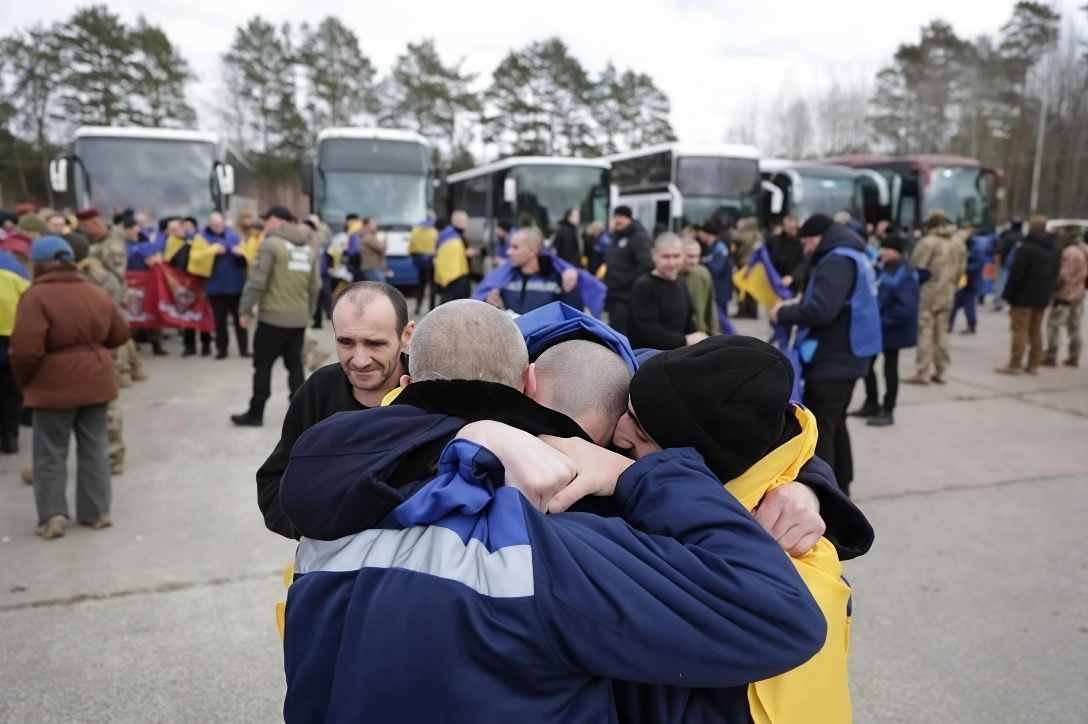
The UAE’s mediation efforts in the Russia-Ukraine war did not begin at the political negotiating table. They started with a specific humanitarian issue: returning prisoners to their families.
As prisoner exchanges became more frequent and expanded in scope, this track developed into a sustained channel of communication between Moscow and Kyiv.
It also coincided with Abu Dhabi hosting political talks involving Russia, Ukraine and the United States.
This development reveals a gradual model of mediation. It begins with an issue on which progress remains possible despite the continuation of war, then builds on the resulting trust and communication to advance broader diplomatic efforts.
Prisoner exchanges provided the most practical starting point for UAE mediation.
These operations require continuous communication between the two sides, agreement on names and numbers, and arrangements for handovers, logistics and security. None of these can be completed without mutual consent.
By October 23, 2026, the UAE had successfully conducted 27 mediation efforts to facilitate prisoner exchanges, resulting in the release of 8,537 prisoners from both sides, according to the UAE Ministry of Foreign Affairs.
In the latest operation at the time, the two countries exchanged 540 prisoners, with 270 from each side.
The Kingdom of Bahrain also welcomed the success of the UAE’s mediation efforts, which resulted in the latest prisoner exchange.
This cumulative record shows that UAE mediation was not an isolated initiative tied to a passing political circumstance.
Instead, it became a recurring process that maintained continuity despite setbacks in efforts to end the war.
Assessing the approach, Dr Mohammed Ibrahim Al Dhaheri, Deputy Director General of the Anwar Gargash Diplomatic Academy, said the UAE model combines “strategic neutrality and active diplomacy”, enabling it to build confidence and achieve tangible results.
This distinction is essential to understanding how the mediation evolved. Neutrality alone does not produce agreements, just as diplomatic engagement without mutual trust may fail to deliver results.
By maintaining relations with both sides while focusing on an actionable humanitarian issue, the UAE established a communication channel that endured across multiple rounds.
From Russia-Ukraine prisoner exchanges to Abu Dhabi peace talks
As the UAE’s role in the prisoner file expanded, Abu Dhabi also emerged as a venue for political talks between Russia, Ukraine and the United States.
Its mediation therefore moved to a different level, extending beyond agreements on detainee lists to providing an environment for meetings addressing the future of the war and possible pathways towards ending it.
Last February, Anwar Gargash, Diplomatic Adviser to the UAE President, said both Russians and Ukrainians viewed the UAE as a facilitator of dialogue, while the United States considered Abu Dhabi a venue where such talks could continue.
Gargash also noted that humanitarian mediation in the prisoner file had strengthened the UAE’s image as a neutral platform.
This illustrates the connection between the humanitarian and political tracks, without suggesting that success in the former automatically guarantees progress in the latter.
In April, Dr Al Dhaheri said the UAE’s credibility as a mediator stemmed from a consistent foreign policy grounded in dialogue and balanced relations.
He added that hosting the trilateral talks had provided space for discussions on some of the most sensitive issues.
Abu Dhabi peace talks test the transition to broader agreements
The Abu Dhabi talks in November 2026 revealed both the limits and the potential of this progress.
During discussions led by the United States and hosted by the UAE on November 10 and 11, Russia and Ukraine reached a preliminary understanding on a major prisoner exchange.
However, the most complex political issues, particularly territorial matters, remained unresolved.
Ukrainian President Volodymyr Zelenskyy said discussions had addressed a formula for exchanging 1,000 prisoners for 1,000, with the possibility of increasing the numbers to 1,500 for 1,500.
These figures were proposals raised during negotiations, not a final announced outcome or an exchange operation that had already taken place.
This round demonstrates that the transition from humanitarian mediation to political negotiations does not mean all issues have equal prospects for resolution.
Prisoner exchanges allow the two sides to reach specific, implementable and verifiable agreements.
Territorial disputes and security guarantees, by contrast, involve strategic and sovereign interests that are difficult to reconcile.
The evolution of the UAE’s role can be assessed across three distinct levels.
The first is the direct humanitarian outcome, measured by the number of exchange operations and prisoners released.
The second is the continued existence of communication channels between the two sides, allowing negotiations to proceed even during periods of escalation.
The third is the provision of a platform for political talks, a level that requires partnerships with powers capable of influencing the course of the war.
In this sense, UAE mediation has not yet advanced to a settlement of the Russia-Ukraine war. However, it has moved beyond separate humanitarian initiatives.
The UAE has established a sustained channel of communication, while Abu Dhabi has become a venue for high-level political meetings.
The next step remains dependent on the willingness of Moscow and Kyiv to make concessions on fundamental issues.
Breaking headlines across the rest of the African continent as they happen: NOWinSA Africa news coverage.