

Participants in the planned June 30 anti-immigration protests may not carry firearms, air guns, spears, sjamboks or knobkerries during demonstrations, police leaders said on Monday.
Law enforcement officials stated they are prepared for “any eventuality” ahead of the nationwide actions.
The security operations for these nationwide demonstrations will impact public funds, pushing the total June 30 march taxpayer cost to an estimated R600 million
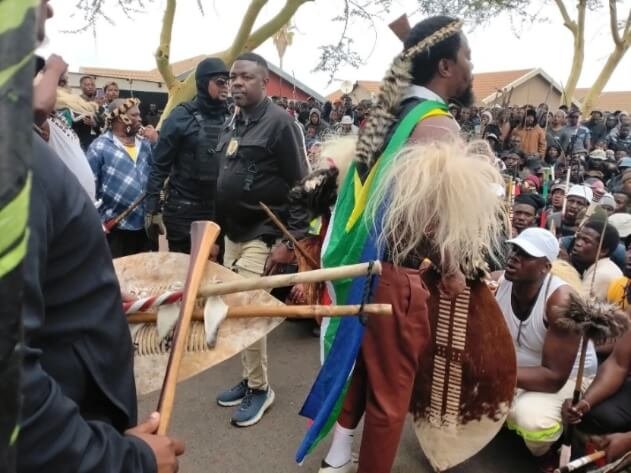
Tensions escalated on Saturday morning when an anti-immigration protest in Parklands, Cape Town, started with a confrontation between March and March protesters and Public Order Police over the carrying of knobkieries and sticks.
Dozens of people joined the Cape Town demonstration, calling for a tougher stance on foreign nationals.
Public Order Police and Metro Police delayed the march on Main Road after ordering participants to surrender their weapons.
Protesters, draped in South African flags, stood in front of a notorious block of flats gesturing to residents about the June 30 deadline.
SAPS answers NOWinSA question on prohibited weapons
The latest clashes follow an explicit warning from police leadership regarding weapon compliance.
During the national security briefing, NOWinSA directly questioned the panel to clarify exactly which traditional and conventional items marchers are legally prohibited from carrying on June 30.
Responding directly to our questions, Deputy National Commissioner for Policing Lt Gen Tebello Mosikili said the law leaves no room for interpretation.
“What do we mean by a dangerous weapon? It is prohibited and there is no debate about it,” she said.
Strict operational enforcement on traditional items
Mosikili said police will not allow participants to carry either traditional or conventional weapons during the demonstrations. That includes guns, airsoft guns, sjamboks, spears, and knobkerries.
“I might be a law graduate but I’m not a law,” she said. “If the law says do not carry a weapon, it means a weapon. And from operational point of view, it says do not carry a weapon. That somebody next door will feel threatened if you are brandishing such an instrument. That will include a spear.”
“A spear, you are, marching … Why do you carry the spear while you are marching? Because we are not at war,” she told the media briefing.
The warning comes weeks after thousands joined an eMalahleni anti-immigration march in Mpumalanga as border security debates intensified across the country.
Contextual evaluation of objects
She added that assegais, knobkerries and sjamboks are equally prohibited.
“Air guns, firearms, any kind of weapon or object is prohibited. You can have a pen and kill a person with a pen but you need to have that distinction,” she said.
The full exchange was documented by our team, and readers can view the exclusive press footage directly via our X news account.
What the Dangerous Weapons Act says
South African law prohibits participants from carrying dangerous weapons during gatherings and demonstrations.
The Dangerous Weapons Act, 2013 defines a dangerous weapon as any object, other than a firearm, capable of causing death or inflicting serious bodily harm if used for an unlawful purpose.
The amended Regulation of Gatherings Act further states that no participant at a gathering may possess any air gun, firearm, imitation firearm, or muzzle-loading firearm.
Any object likely to be mistaken for a firearm or any dangerous weapon is also barred. Conveners and marshals must take reasonable steps to ensure participants comply with the law.
These ongoing migration tensions have already triggered state interventions, building on our first-hand, on-the-ground coverage of the Ghana repatriation from South Africa process, alongside recent updates regarding the Nigeria repatriation 2026 registration framework.
Defence readiness and contingency plans
Acting Police Minister Firoz Cachalia confirmed that SAPS is the lead agency for maintaining public order.
He noted that the South African National Defence Force (SANDF) remains on standby to augment police capacity if critical infrastructure is threatened.
Defence Minister Angie Motshekga previously stated there are no current plans for active military deployment.
To prevent disruptions on major transport routes, authorities have heavily increased collaborative SANTACO and SAPS taxi operations to monitor critical transport networks.