


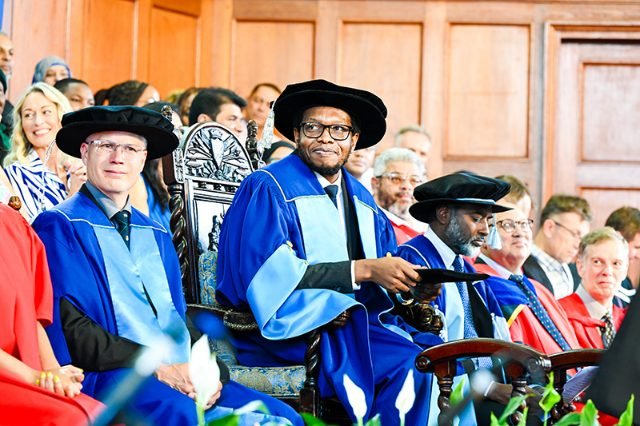
Cape Town’s top university has moved down the global academic rankings, and its vice-chancellor is not letting the headline number tell the whole story.
The 2026 Academic Ranking of World Universities (ARWU) placed the University of Cape Town (UCT) at 286th globally, down 28 places from its 258th position in 2025.
For context, our full breakdown of Africa’s top 10 ARWU universities shows where UCT and the continent’s other leading institutions placed in the latest ranking.
UCT remains inside the world’s top 300 and Africa’s top-ranked university for a 24th consecutive year.
The shift prompted vice-chancellor Professor Mosa Moshabela to write directly to UCT staff and students.
In a letter dated August 18, 2026, he unpacked the indicators behind the movement and explained why the 28-place change needs to be read in context.
Moshabela: “It is important to look beyond the headline position”
Moshabela opened his letter by acknowledging that the movement would draw attention.
He wrote that he recognised “a movement of 28 places may raise questions, particularly given the importance we place on UCT’s research excellence and international standing.”
Rather than dismissing the result, he focused on what sits behind the headline number.
“It is therefore important to look beyond the headline position and understand what the underlying data tells us,” he said.
That explanation centres on how ARWU measures university performance and how UCT’s scores changed across its six indicators.
The indicators behind UCT’s ARWU ranking movement
ARWU uses six indicators covering Highly Cited Researchers, major academic awards, publications in Nature and Science, Web of Science-indexed papers and per-capita academic performance.
Moshabela broke down UCT’s performance indicator by indicator.
“Our score for Highly Cited Researchers increased from 2.9 to 3.3, while our Alumni score remained unchanged at 1.6,” he wrote.
Three indicators moved in the opposite direction.
“Three indicators declined: our score for Web of Science-indexed publications moved from 7.3 to 6.7; the Nature and Science indicator moved from 2.8 to 2.7; and per-capita academic performance moved from 1.8 to 1.7.”
The figures help explain how UCT’s overall position changed, but Moshabela cautioned against treating the scores as a direct measure of the university’s absolute research output.
Why a lower ARWU score does not necessarily mean lower output
Moshabela was direct about what the numbers do — and do not — show.
“ARWU scores are relative measures, benchmarked against the highest-performing university on each indicator,” he explained.
“A change in an indicator score therefore does not necessarily mean that UCT’s absolute research output has fallen by the same proportion – or even that it has fallen at all.”
In other words, UCT’s output can remain stable while its position relative to the strongest-performing universities changes.
Moshabela also pointed to the changing data periods used in the ranking.
“The publication indicator in the 2026 ranking uses publications from 2025, while the previous edition used publications from 2024,” he wrote.
That means year-on-year comparisons do not simply measure the same body of research against a fixed benchmark.
Why UCT’s ARWU result differs from other rankings
Moshabela also urged the university community not to view the UCT ARWU ranking in isolation.
He pointed to UCT’s performance across other major global university rankings:
- 184th globally and first in Africa in the QS World University Rankings 2027
- 164th globally and first in Africa in the Times Higher Education World University Rankings 2026
- 276th globally and second in Africa in the latest CWUR index
“Each ranking measures different dimensions of university performance,” he wrote.
ARWU places a particularly strong emphasis on research output and academic research indicators, while QS, THE and CWUR use different combinations of measures, including reputation, teaching, research and employability.
The different results therefore do not necessarily contradict one another. They reflect different methodologies and priorities.
“We should take those signals seriously”
Moshabela did not suggest that UCT should ignore the decline.
Instead, he presented the result as information the university should use.
“We should take those signals seriously,” he wrote. “At the same time, we should not lose sight of the broader picture: UCT remains among the world’s leading research-intensive universities.”
He connected that broader picture to UCT’s future plans.
Mashabela said the university urgently needs to advance its Strategy 2030 interventions to remain a leading institution in an increasingly competitive higher education landscape.
Where South Africa’s other universities stand
UCT’s 201–300 global band remains the strongest result for any South African university in the 2026 ARWU rankings.
Wits follows in the 301–400 range, while Stellenbosch University and the University of Pretoria sit in the 401–500 and 501–600 bands respectively.
The University of KwaZulu-Natal shares the 601–700 band with the University of Johannesburg.
North-West University and Unisa complete South Africa’s representation in the ARWU global top 1,000, both appearing in the 801–900 band.
The full 2026 Academic Ranking of World Universities is published by ShanghaiRanking Consultancy.
ALSO READ: 2025 matric results: Top 10 best-performing private schools and students in South Africa