


Military escalation continues across the Middle East. On Monday, Yemen’s Iran-backed Houthis announced that they had targeted Dammam Airport in eastern Saudi Arabia twice over the preceding 48 hours.
The announcement followed a statement by the Saudi-led military coalition supporting Yemen’s internationally recognised government that it had intercepted projectiles targeting Riyadh.
The Houthi attacks on Saudi Arabia have intensified since early October, with Saudi authorities reporting at least 21 deaths in attacks on the kingdom’s airports.
The conflict escalated last September when Iran-aligned fighters launched an offensive in western Yemen.
The offensive strengthened their control over areas near the Bab al-Mandab Strait, a strategic maritime passage linking the Red Sea to the Gulf of Aden.
The attacks included strikes on Riyadh Airport. One attack on 10 October killed 13 people and injured hundreds, marking the deadliest assault on Saudi territory in more than a decade.
The Houthis have shown no intention of ending their attacks, prompting Riyadh to seek support from countries it considers friendly.
Yet its efforts to secure military assistance have reportedly met resistance.
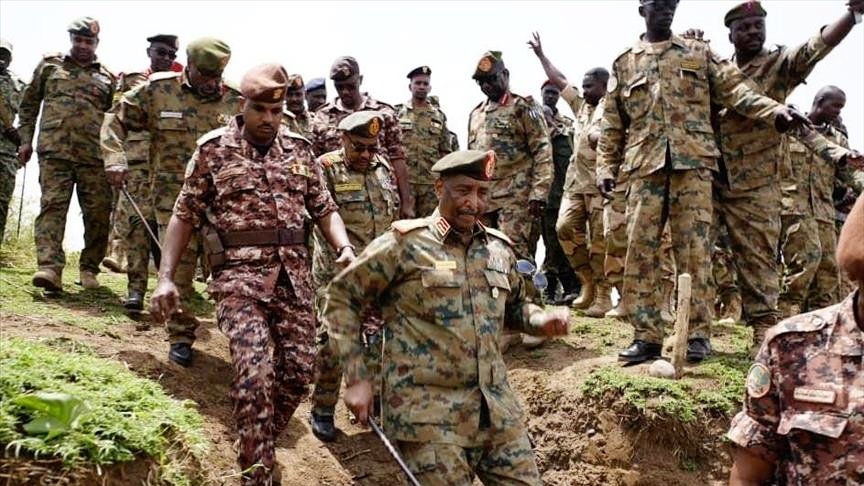
In this context, Port Sudan’s army chief, Abdel Fattah al-Burhan, reportedly rejected a Saudi request to deploy fighters to Yemen alongside forces loyal to Riyadh against the Houthi movement, according to a private source.
The source said Riyadh had requested Sudanese military units to support its allies on the ground.
Port Sudan, however, declined to deploy troops despite previously being regarded as one of al-Burhan’s closest regional partners.
The reported refusal comes as Saudi Arabia and the UAE strengthen security coordination amid rising Houthi attacks and growing concerns over Yemen’s future and control of strategic Red Sea shipping routes.
Saudi Arabia and al-Burhan
Since mid-April 2023, Sudan has been engulfed in a war between the army based in Port Sudan and the Sudanese Founding Alliance Forces, known as Tasis.
The conflict has triggered one of the world’s largest humanitarian crises, killing approximately 200,000 people and forcing around 14 million others to flee their homes, according to figures cited in the report.
External support for the opposing sides has fuelled the fighting and deepened civilian suffering.
Al-Burhan has rejected humanitarian initiatives in favour of a military resolution, despite mounting international pressure to end the war.
Saudi Arabia has been among his supporters, although Riyadh has also acknowledged that external backing for the warring parties prolongs the conflict and worsens Sudan’s humanitarian crisis.
A Reuters report, citing two Pakistani security sources and a diplomatic source, said Islamabad had halted a $1.5 billion deal to supply weapons and aircraft to Sudan after Saudi Arabia requested its cancellation.
The report said Riyadh would no longer finance the purchase following its mediation efforts.
Reuters reported last January that Saudi Arabia had mediated the agreement, although Riyadh’s financial involvement had not been disclosed at the time. The deal was then in its final stages.
The agency said the agreement formed part of several arms sales negotiated by Pakistan’s military after its aircraft and weapons systems gained prominence during clashes with India in May 2025.
The proposed deal involved supplying the Sudanese army with military aircraft and weapons.
Two sources previously said it included approximately 10 Karakoram-8 light attack aircraft, more than 200 reconnaissance and attack drones, and advanced air defence systems.
Shifts in the balance of power favour Iran
While Saudi Arabia has provided Port Sudan with financial and diplomatic support, Iran has emerged as a key player in Sudan’s conflict.
Tehran has supplied and trained battalions affiliated with Sudan’s Muslim Brotherhood, providing them with military equipment and technical support.
Iran views Sudan as a strategic location from which to strengthen its regional proxies.
Through its engagement with Port Sudan, Tehran has reportedly exploited Sudanese ports to smuggle weapons to the Houthis across the Red Sea.
A report by The Sentry International said Sudan had evolved beyond a country bordering the Red Sea into part of a regional Houthi network.
Since 2022, the network has reportedly facilitated smuggling, logistical support, intelligence activities and military technology transfers through ports and coastal routes.
The report, published in 2026, identified Sudan’s coastline, particularly Suakin Port, as a major logistical hub in the network.
The Houthis have allegedly used the port to expand their operations beyond Yemen.
The report described Suakin as a logistical hub for Red Sea smuggling operations, with local Sudanese networks facilitating the movement of personnel and equipment.
Researchers also compiled a map using Global Fishing Watch vessel-tracking data, identifying ships allegedly involved in smuggling and transportation operations linked to the network between 2022 and 2025.
The Houthis have also reportedly transferred low-cost Iranian military technology to Sudan, including drone manufacturing capabilities, missile-related systems and technical expertise for assembly and local production.
Close ties with Islamists
The Sentry report described the Red Sea as one of the most important logistical corridors for the Houthi network.
Beyond military equipment smuggling, the corridor reportedly facilitates technology transfers, personnel movements and connections between Yemen, Sudan and the wider Horn of Africa.
Other reports allege that the Houthis have worked with transnational smuggling networks to transfer Iranian military technology to armed groups in Sudan.
These groups are believed to be affiliated with the Sudanese Islamic Movement and have reportedly received drones and missiles.
Last March, US President Donald Trump’s senior adviser for Arab and African affairs, Massad Boulos, said Iran’s Islamic Revolutionary Guard Corps had trained and supported fighters linked to Sudan’s al-Baraa Brigade.
In a post on X, Boulos recalled that Washington had previously imposed sanctions on the al-Baraa bin Malik Brigade.
He also referred to reports of field executions targeting civilians on racial or ethnic grounds in Sudan.
Islamists in control
Islamists wield significant influence over decision-making in Port Sudan, particularly within the army leadership.
They have been accused of obstructing peace efforts and prolonging the conflict while seeking to consolidate their political and military influence.
Despite these concerns, Riyadh had previously appeared inclined to favour the camp.
Islamist-aligned forces reportedly oversee a military network comprising approximately 117 battalions and armed factions allied with Port Sudan’s army.
These include the al-Baraa bin Malik, al-Bunyan al-Marsous and al-Barq al-Khatif battalions, alongside the Sudan Shield Forces, Sudan Liberation Movement and Justice and Equality Movement.
Reports indicate that members of factions allied with Port Sudan have received training in Eritrea, while others underwent training under Iran’s Islamic Revolutionary Guard Corps.
These arrangements reflect the expansion of Sudan’s military relationships beyond its borders, adding regional channels of support and coordination to the factions’ domestic influence.
The United Nations and Human Rights Watch have documented alleged war crimes and crimes against humanity by factions allied with Port Sudan’s forces. These include indiscriminate airstrikes and field executions.
A separate US investigation into alleged ethnic war crimes in Sudan has also implicated Port Sudan forces in atrocities in Al-Jazirah State.
The reported refusal to deploy Sudanese troops to Yemen raises broader questions about Riyadh’s regional partnerships.
It also highlights the growing influence of Iran-aligned networks and the future of security cooperation across the Red Sea.