

South African motorists are set for a major boost to their December budgets as a perfect storm of global and local market forces drives fuel prices downward.
A sharp 5% drop in global oil prices combined with a resilient local currency has significantly deepened the expected petrol price cuts for next month.
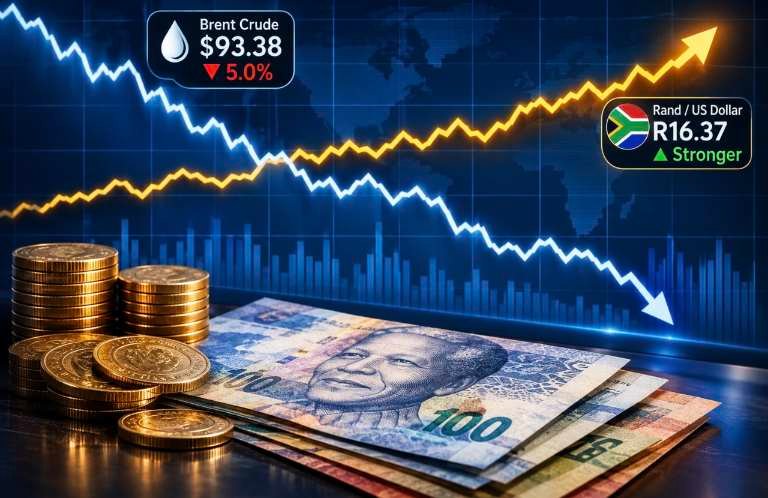
In recent trading, Brent Crude plummeted to $93.38 a barrel, while the South African Rand firmed dramatically to R16.37 against the US Dollar.
As we reported in our initial December 2026 fuel price forecast, early data already pointed to a petrol drop.
This week’s global market crash has made those festive savings even bigger.
However, while petrol consumers can celebrate a massive windfall, the outlook for diesel remains complex.
Here is exactly how the global oil crash is deepening your December petrol savings, and why diesel faces a stiffer headwind to stay in the green.
1. The oil price crash and the over-recovery
South Africa determines domestic fuel price adjustments via a daily calculation known as the over-or-under recovery.
This tracks the difference between the government-set retail price and the actual cost of importing refined fuel.
Monday’s global market plunge means the price of refined fuel arriving at coastal ports is suddenly far cheaper than current domestic retail rates.
This widening gap locks in substantial downward momentum for a heavy petrol price cut.
According to market analysts, Brent Crude’s upward momentum has been thoroughly disrupted, with prices falling well below key moving averages.
If global prices break below the critical $92.80 mark, it could trigger further downside toward the $88.21 support level.
You can read the full TradingKey analysis on the Brent Crude price forecast for a deeper look at these market dynamics.
2. Macro relief for the Rand
Because South Africa imports 100% of its crude oil requirements, purchasing oil requires massive outlays of US Dollars.
When global oil values drop this sharply, it eases long-term pressure on our national trade balance.
This macro relief aligned with a broader wave of positive market sentiment on Monday, helping the South African Rand firm significantly to trade in the R16.37–R16.45 range against the greenback.
As a net importer of fuel, a stronger Rand is a critical secondary engine for local relief, as it directly lowers the domestic cost of clearing imported crude at our ports.
The counter-effect: Government tax relief is scaling back
While the oil price drop and a firmer Rand provide a massive downward cushion, there is a major regulatory factor offsetting these market gains: the scheduled reduction of National Treasury’s temporary fuel levy relief.
Earlier this year, government introduced temporary R3 fuel levy relief to cushion consumers against rising fuel costs.
The measure was eventually phased out, with the full levies restored from July. Treasury reintroduced a temporary two-month levy cut in November to ease the pressure of steep price hikes.
However, that relief is set to step down in December as follows:
- Petrol: Relief scales down by 50 cents per litre (dropping from R1.50 to R1.00 per litre).
- Diesel: Relief scales down by R1.50 per litre (dropping from R3.00 to R1.50 per litre).
This subsidy rollback claws 50 cents back onto petrol and R1.50 back onto diesel.
Because the oil crash generated a massive over-recovery for petrol, it easily absorbs the 50-cent tax hike to deliver a net cut of over R1.00.
Diesel’s market over-recovery, however, was much smaller—meaning the steep R1.50 tax clawback completely wipes out its global oil gains, pushing diesel into a net increase.
What will you actually pay in December?
When you combine the highly favourable market over-recoveries with the reduced fuel levy relief, here are the projected retail pump prices for December 2026:
| Fuel Type | Projected Change | Expected Dec Price (Gauteng) |
|---|---|---|
| Petrol 93 | – R1.03 | R28.34 |
| Petrol 95 | – R1.34 | R28.56 |
| Diesel 0.05% | + R1.15 | R32.00 |
| Diesel 0.005% | + R1.22 | R32.82 |
Note: For the latest current pump rates and historical price trends, visit our official petrol and diesel prices hub.
What about inflation and interest rates?
Monday’s plummet acts as an immediate safety valve for the South African Reserve Bank (SARB).
Lower global oil values rapidly cool down input costs across the manufacturing, logistics, and agricultural sectors, easing domestic inflation projections just ahead of the festive shopping rush.
With transport inflation held firmly in check, economists are increasingly confident that local interest rates can remain stable or continue a steady downward cutting cycle well into 2027.
When will the official December prices be announced?
The Department of Mineral Resources and Energy (DMRE) will make the official price announcement on the Monday or Tuesday immediately before the first Wednesday of December 2026.
We will update this page with the finalized gazetted rates as soon as the official figures are released.
For current pump rates and real-time local trends, visit our official petrol and diesel prices hub.