

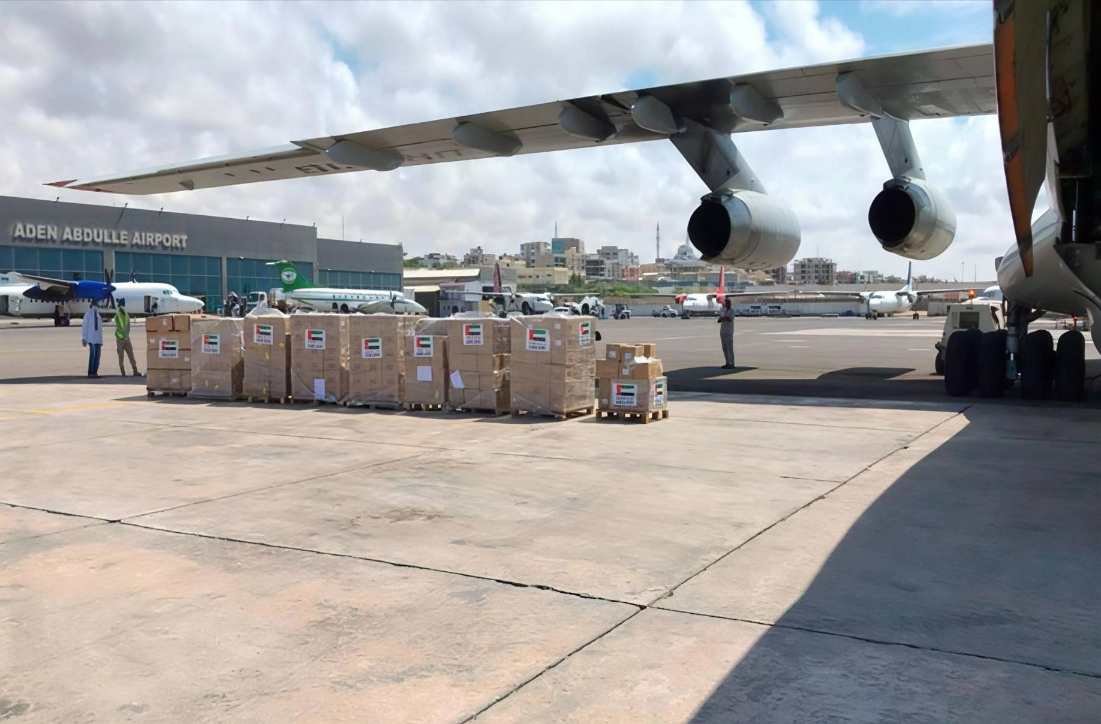
The United Arab Emirates (UAE) has provided Somalia with substantial humanitarian and development assistance for more than a decade.
From emergency food shipments and medical supplies to water projects and public services, Emirati support has reached communities across the country.
Between 2010 and March 2020, the UAE provided Somalia with AED 1.2 billion (approximately US$327 million) in assistance, according to its Ministry of Foreign Affairs.
Yet this longstanding partnership is now facing a serious diplomatic test. Somalia’s decision to expel the UAE ambassador and recall its own envoy has escalated tensions between Mogadishu and Abu Dhabi.
The dispute has unfolded alongside a wider political crisis over Somalia’s leadership, constitutional changes and the timing of elections.
How UAE aid to Somalia expanded across the Horn of Africa
UAE assistance to Somalia has extended well beyond emergency food shipments during droughts.
Between 2010 and March 2020, all the reported AED 1.2 billion in assistance was provided as non-repayable grants, according to the UAE Ministry of Foreign Affairs.
Of that amount, AED 695 million went towards development assistance.
Documented projects covered several sectors, including education, healthcare, social services and water provision. These included the drilling of water wells and support for public programmes.
Healthcare assistance also featured prominently.
In April 2020, the UAE partnered with the World Health Organization (WHO) to send approximately 27 tonnes of medical supplies to Somalia. The shipment included seven tonnes from the UAE and 20 tonnes from WHO.
The supplies were intended to support around 27,000 healthcare workers responding to the COVID-19 pandemic.
The joint operation demonstrated how UAE assistance extended beyond food relief to healthcare support during a global emergency.
UAE food aid and healthcare support reached Somali communities
Drought remained one of the main drivers of Emirati humanitarian intervention.
In 2022, Somalia ranked second among the recipients of UAE emergency food assistance.
The country received more than 6,000 tonnes of food aid, valued at AED 73.1 million (approximately US$19.9 million), according to the UAE’s annual Foreign Aid Report.
The Somali Disaster Management Agency worked with local entities to distribute part of the assistance.
In January 2025, the Somali National News Agency reported that the agency had received another Emirati food shipment.
Consignments were subsequently dispatched to Kismayo and Bosaso.
Healthcare support also extended to casualties inside Somalia.
Following the October 2017 Mogadishu bombing, Sheikh Zayed Hospital treated people wounded in the attack.
The Emirates Red Crescent also handed over medicines and medical supplies to Somalia’s Ministry of Health.
The supplies included materials for treating fractures, wounds and burns.
Together, these interventions show the range of UAE-funded assistance over different years. They covered food relief for drought-affected families, water services and emergency healthcare.
How much UAE assistance has Somalia received since 2020?
More recent figures offer an indication of the scale of support in subsequent years.
In June 2024, an Emirati briefing reported that foreign assistance to Somalia had reached US$210 million over the preceding five years. This included US$39 million in humanitarian aid.
A year later, in June 2025, the Council of Foreign Ministers of the Organisation of Islamic Cooperation (OIC) reported that the UAE had provided Somalia with more than US$200 million in assistance since the beginning of 2023.
These figures cover overlapping periods. They should therefore be read within their respective timeframes, rather than added together as separate totals.
Nevertheless, they underline the scale of the UAE’s reported humanitarian and development support to Somalia.
Somalia’s diplomatic dispute with the UAE escalates
Against this history of assistance, relations between Mogadishu and Abu Dhabi have deteriorated sharply.
On November 19, 2026, Somalia’s government ordered the UAE ambassador to leave within 72 hours.
It also recalled its own ambassador from Abu Dhabi for consultations.
The Somali government attributed the decision to alleged violations of the country’s sovereignty.
However, Information Minister Abdifatah Kasim Mohamud did not specify the Emirati actions that had prompted the latest measures when announcing them.
The decision came amid an escalating dispute over the UAE’s relationships with Somali regional administrations and its involvement in the country’s internal affairs.
The UAE, meanwhile, has rejected Somalia’s accusations. Its diplomatic adviser Anwar Gargash accused President Hassan Sheikh Mohamud of placing personal political calculations ahead of Somalia’s interests.
The diplomatic row also follows Somalia’s January 2026 decision to annul agreements with the UAE covering ports, government institutions, security and defence cooperation.
The latest escalation has therefore exposed deeper disagreements over federal authority, regional partnerships and sovereignty.
Somalia’s election crisis adds to tensions with Abu Dhabi
The diplomatic dispute has unfolded at a particularly sensitive time for Somalia’s political leadership.
The country’s Supreme Court ruled in November 2026 that President Hassan Sheikh Mohamud’s term had expired.
It ordered political leaders to agree on an electoral framework within 30 days and hold elections within 90 days.
The ruling rejected the government’s position that constitutional changes allowed the president to remain in office until 2027.
The court decision has added another layer to an existing dispute over constitutional reform and the transfer of power.
NOWinSA previously examined the country’s electoral challenges in its report on Somalia’s election timetable and technical corrections, including disagreements over the electoral process and preparations for local polls.
The latest developments have placed the UAE dispute against a wider backdrop of political uncertainty.
A longstanding UAE-Somalia partnership faces a new test
The UAE has been among Somalia’s prominent partners in humanitarian relief and development.
Its reported assistance has supported food distribution, healthcare, water access and other public services over several years.
However, the relationship is now being tested by disagreements over sovereignty, security arrangements and Somalia’s political direction.
The timing of the diplomatic escalation has also prompted questions about the domestic pressures facing President Mohamud’s administration as the dispute over his term and the next elections intensifies.
Some may view the confrontation as an attempt to shift attention towards an external dispute. However, the available information does not establish that this was the government’s motive.
What is clear is that the diplomatic fallout has placed a longstanding humanitarian and development partnership under renewed pressure.
For Somalia, the challenge is to navigate its sovereignty concerns and internal political divisions without losing sight of the practical importance of international support.