


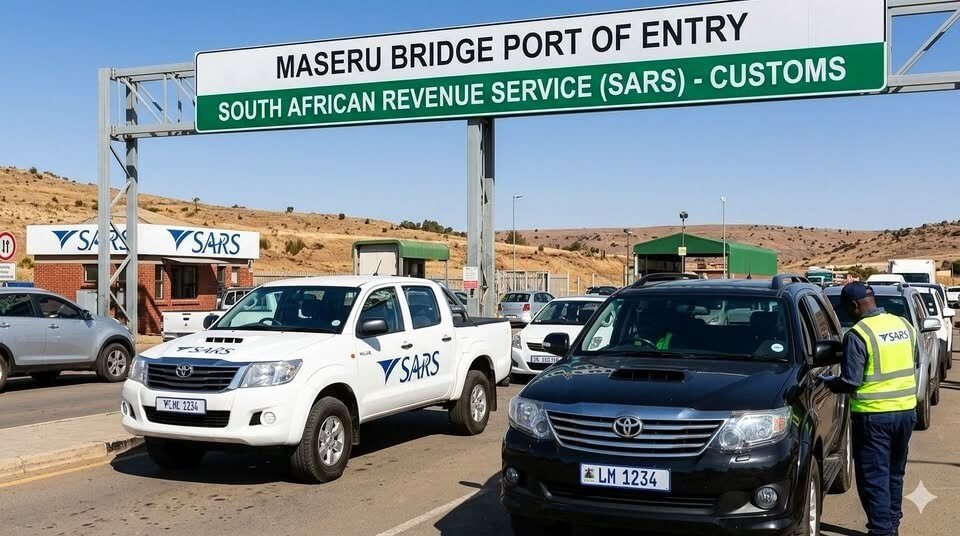
Nearly 39,000 foreign-registered vehicles have already been declared through South Africa’s new SARS traveller declaration system as mandatory customs declaration rules came into effect at all land borders.
JOHANNESBURG — From June 1, 2026, every driver entering or leaving the country in a foreign-registered vehicle must first complete an online customs declaration through the SARS Traveller Management System (TMS) before arriving at any land border post.
The rule applies to all foreign number plates, including vehicles from Botswana, Lesotho, Namibia and Eswatini within the Southern African Customs Union (SACU).
As outlined in our previous coverage, the digital overhaul ends the long-standing informal system that allowed motorists to rely mainly on manual declarations.
NOWinSA has extensively followed SARS’ border modernisation programme, including Commissioner Makhubu’s digital strategy.
SARS confirmed in Monday that more than 38,900 Temporary Import Permits (TIPs) had been issued by May 31, 2026, demonstrating strong early compliance.
The revenue service has deployed senior officials at major ports including Skilpadshek, Kopfontein, Maseru Bridge and Ficksburg Bridge to monitor implementation and assist travellers.
What the SARS traveller declaration system means for drivers
Under the new SARS border rules, all foreign-registered vehicles entering Sa must be declared to Customs and issued a TIP at the border.
The temporary permit allows a foreign vehicle to be used legally in South Africa for up to six months and permits multiple entries and exits within that period without requiring a fresh permit for each trip.
Frequent cross-border travel for work, study, business or medical care does not affect the permit’s validity, provided it remains active and is renewed before expiry.
There is no fee for submitting an online traveller declaration or for obtaining a TIP.
Travellers can pre-declare through the SARS traveller declaration portal or via the SARS MobiApp.
Those unable to complete the process online will be assisted at ports of entry using on-site digital kiosks.
Why SARS is enforcing foreign vehicle declaration rules
The stricter controls are grounded in Section 15 of the Customs and Excise Act No. 91 of 1964, which has always required travellers to declare all goods, including vehicles.
But SARS says abuse of passenger channels has surged, with commercial traders using foreign-registered vehicles to move undeclared stock across borders while avoiding import duties.
SARS and industry bodies say the financial impact is significant.
According to Naamsa, grey vehicle imports – used vehicles brought in through unauthorised channels – cost the fiscus up to R8 billion annually in lost import duties, VAT and other taxes.
That figure has more than doubled from R3.8 billion in 2020.
The National Automobile Dealers’ Association (NADA) estimates that around 50,000 illegal vehicles are added to South Africa’s roads each year.
Over the past five years alone, half a million foreign-registered plates recorded operating locally.
NADA warns that many grey imports fail to meet local quality, safety and environmental standards, undermining legitimate dealerships and threatening jobs.
Commissioner Makhubu: ‘Compliance is not optional’
SARS Commissioner Dr Johnstone Makhubu was on the ground at key border posts on launch day, reinforcing the legal basis of the requirements.
“The obligation to declare goods and vehicles at our borders is firmly rooted in South African law, which clearly states that everyone must declare everything they bring into or take out of the country,” Makhubu said.
He noted that even vehicles from SACU countries must be declared without exception.
“SACU arrangements facilitate trade, but they do not remove customs control. A vehicle registered outside South Africa remains a foreign vehicle under our law and must be declared as such.”
Makhubu also addressed the risk of border delays: “Where vehicle owners comply with all the legal requirements, the process will be seamless. However, where compliance is low, this may lead to delays in border crossings.”
How to complete a SARS foreign vehicle declaration
| Step | Action |
|---|---|
| 1 | Visit the SARS traveller declaration portal or open the SARS MobiApp |
| 2 | Capture passport information, travel dates, engine number and vehicle registration |
| 3 | Complete Traveller Declaration Form DA 331 if transporting commercial goods or currency exceeding R25,000 |
| 4 | Submit to receive an SMS or email confirmation code |
| 5 | Present the code to border officials on arrival |
Online pre-declaration does not replace physical border controls. All travellers must still present themselves for customs verification and may undergo inspection where required.
What happens if you fail to complete a SARS traveller declaration
Motorists who fail to complete the online declaration or provide false or incomplete information risk vehicle detention, fines, processing delays and possible asset forfeiture.
SARS has made clear that non-compliance will attract enforcement consequences.
For travellers already inside South Africa with foreign-registered vehicles, SARS advises making a declaration at the nearest port of entry before the next exit or upon leaving the country.
👉🏾 Follow NOWinSA for real-time updates on SARS border rules, foreign vehicle declarations and cross-border compliance.