

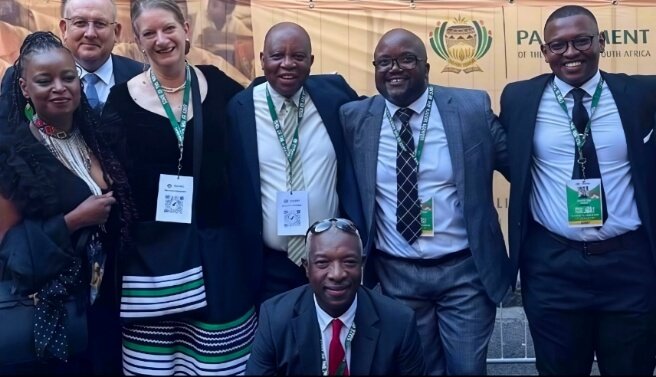
JOHANNESBURG — ActionSA regional chairperson and former 2024 national election candidate Malibongwe Moses Qwashu has come under fire after posting comments on X targeting South Africa’s Muslim community, renewing scrutiny of the party’s messaging on immigration, religion and national dentity.
The backlash comes just days after ActionSA publicly backed the controversial March and March movement despite mounting criticism of the group’s anti-illegal immigration campaigns.
On June 26, Qwashu posted on his verified X account:
“Muslim must stop annoying South Africans. We are not a damn Islamic Country.”
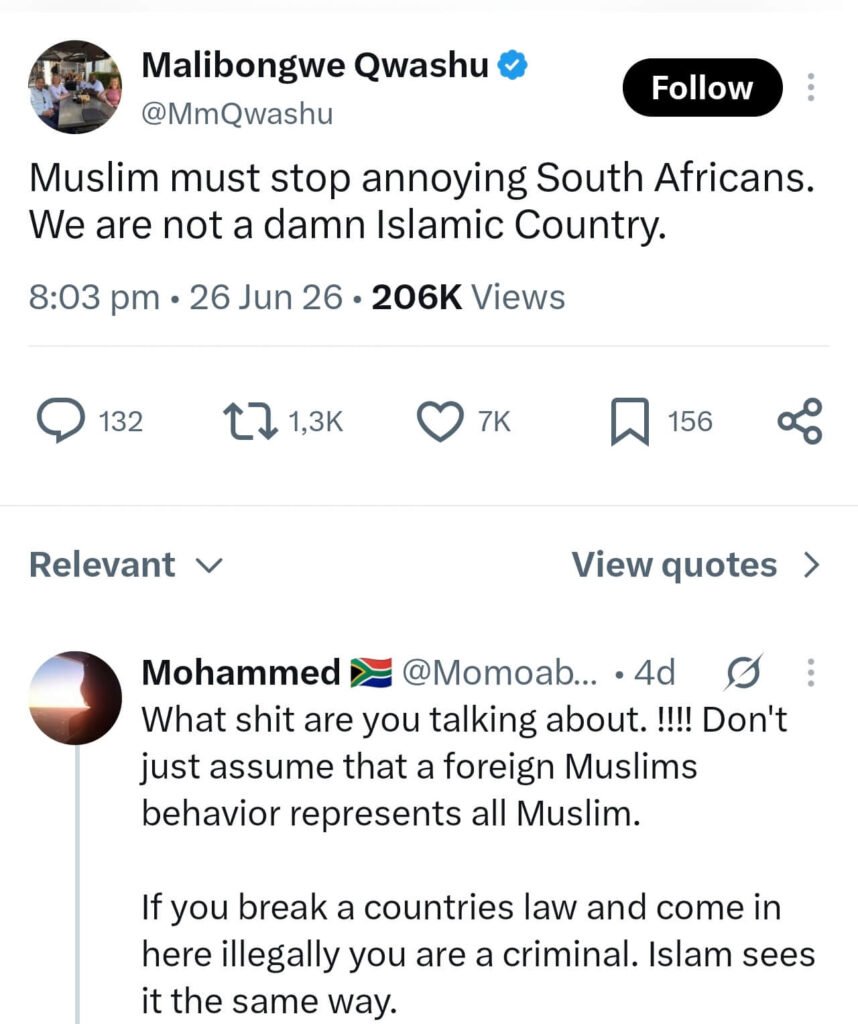
The post attracted more than 206,000 views and drew widespread criticism from users who accused the ActionSA leader of stereotyping an entire religious community instead of addressing specific concerns about illegal immigration.
Anti-Muslim post sparks widespread criticism
Much of the backlash centred on Qwashu’s decision to target Muslims broadly rather than distinguish between undocumented immigrants and South Africa’s Muslim community.
One X user, Mohammed, challenged the statement by replying:
“Don’t just assume that a foreign Muslim’s behaviour represents all Muslims. If you break a country’s law and come here illegally, you are a criminal. Islam sees it the same way. Stop spreading misinformation about Islam and Muslims.”
Rather than responding to the substance of the criticism, Qwashu replied with a single word:
“Tsek.”
The exchange quickly spread across social media, with many users arguing that public representatives have a responsibility to separate debates about immigration enforcement from constitutionally protected religious freedom.
Comments follow growing tensions over immigration
Qwashu’s remarks followed several days of heated online debate after Muslim organisations and individuals criticised the tactics of the March and March movement and defended the constitutional rights of undocumented migrants.
The debate intensified after ActionSA president Herman Mashaba reaffirmed the party’s support for the movement, saying it “represents the lived experiences of many South Africans.”
During a briefing ahead of the June 30 demonstrations, March and March’s Ngobese-Zuma also named and thanked the movement’s political backers — starting with ActionSA, followed by the ATM, AFP, and MK Party among others.
Meanwhile, the South African Human Rights Commission’s legal action against March and March activists argues that preventing undocumented foreign nationals from entering public healthcare facilities violates constitutional rights.
Qwashu also criticised Yusuf Cassim’s appointment
The post was not Qwashu’s only recent comment involving South Africa’s Muslim community.
Following President Cyril Ramaphosa’s latest Cabinet reshuffle, Qwashu criticised the appointment of Deputy Minister of Basic Education Yusuf Cassim, who previously served as chairperson of the Muslim Students Association.
He wrote on X:
“Eish @MYANC and South Africa. We are still waiting for Mngomezulu, Khumalo or Makhoba to be a Minister in Iran, Dubai or somewhere in the Middle East.”
The post drew further criticism from users who argued they conflated religion, nationality and diplomatic representation.
ActionSA faces renewed scrutiny over its messaging
ActionSA states that its core values include non-racialism and the rule of law.
Critics, however, argue that comments targeting an entire religious community risk undermining those principles by shifting the focus from unlawful conduct to religious identity.
The latest controversy also follows debate over Herman Mashaba’s position on BEE and urban transformation, another issue that has prompted questions about the party’s broader political direction.
It also comes months after ActionSA suspended former Tshwane MMC Morodi, adding to a string of controversies involving party leaders and public representatives.
At the time of publication, ActionSA had not announced whether it would take disciplinary action against Qwashu over the social media posts.
South Africa’s Constitution protects both freedom of religion and freedom of expression, while also prohibiting advocacy of hatred that constitutes incitement to cause harm.
The controversy has added fresh scrutiny to how political leaders frame debates around immigration, religion and national identity as parties prepare for next local government elections in November.