

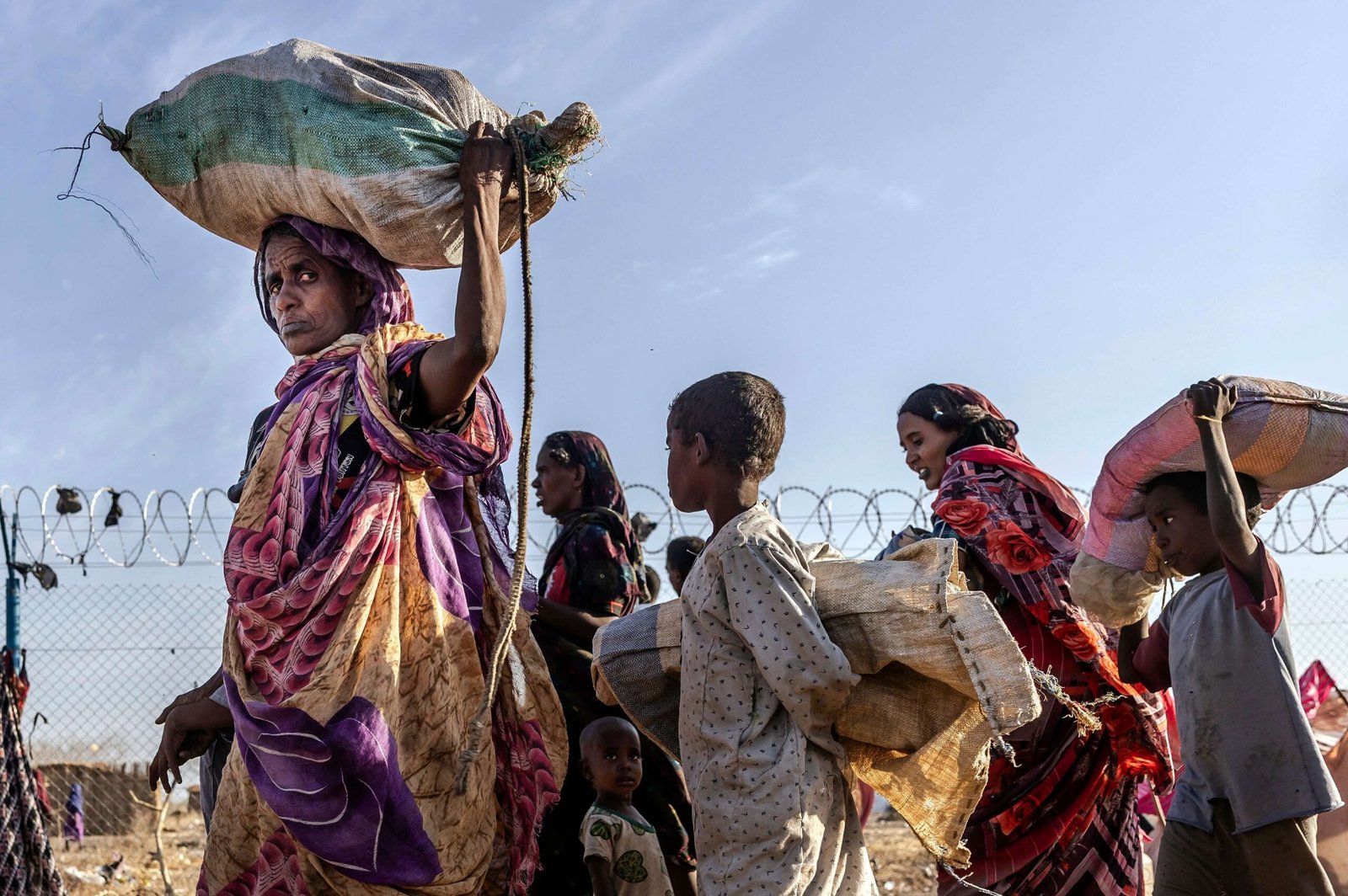
Fresh waves of displacement are putting further pressure on Kriyo camp in East Darfur State, where nearly 2,000 refugees have arrived after fleeing several Sudanese cities.
Camp official Ibrahim Weil told Darfur24 that the new arrivals are struggling to access humanitarian assistance.
Sudan’s war between the army and the Rapid Support Forces (RSF) has continued since April 2023.
Estimates put the death toll at nearly 200,000, while the United Nations says more than 14 million people have been forced to flee their homes.
Weil explained on October 6, 2026, that the newly arrived refugees do not have food ration cards. This prevents them from accessing assistance provided by the World Food Programme (WFP).
“They are dealt with by dividing the share of each individual already residing with them to stave off their hunger for a short period, after which the suffering begins anew,” he said.
Weil called on humanitarian organisations and the United Nations High Commissioner for Refugees (UNHCR) to intervene urgently.
He said the newly arrived refugees must have their status regularised and be added to the lists of aid beneficiaries.
According to the newspaper, Kriyo camp is the largest refugee camp in East Darfur State. It houses around 37,000 refugees from South Sudan, most of whom fled earlier conflicts.
East Darfur has also experienced increasing waves of displacement since the outbreak of the Sudan war on April 15, 2023.
The camps are under mounting pressure as funding for international organisations has dried up and food rations have been reduced.
The cuts have intensified hunger, particularly among newly displaced people who have not yet been registered.
Sudan war fuels fears of wider instability
As the war in Sudan continues, fears are growing that the country could become a major hub for terrorism, particularly given its position at the crossroads of countries facing fragile security situations.
Army commander Abdel Fattah al-Burhan has maintained that the war will not end except through a military victory.
Earlier, Dr Essam Abbas, an information technology and data analysis consultant, warned that Sudan was moving rapidly towards becoming a “hub for terrorism” unless the war ended immediately and urgent measures were taken to rebuild the state on new foundations.
In an interview broadcast by Radio Dabanga, he cited political turmoil, the alleged influence of Islamist extremists and their involvement in the current conflict as factors increasing the risk.
Abbas said Sudan’s three decades under an Islamist-led regime, from 1989 until its fall, as well as its links with extremist Islamist groups, had contributed to the danger.
He warned that, without urgent intervention, Sudan could become a major centre for terrorism and violent extremism and pose a threat to international peace and security.
He also said the state’s failure to resolve the worsening political and economic situation, followed by the outbreak of war, had created fertile conditions for extremist groups to operate.
The Sudan war has devastated the national economy and deepened the humanitarian crisis.
The impact includes rising hunger, destroyed infrastructure, disrupted factories, displaced workers as well as innocent women and children, suspended agricultural projects and deteriorating grazing lands and livestock resources.
Children have also borne the brunt of the conflict, facing displacement and deprivation as the war continues. Sudan’s children have faced years of violence and deprivation.
Sudan’s healthcare system has also come under severe pressure, with the war disrupting access to essential medical services and placing further strain on humanitarian organisations. Read more about Sudan’s healthcare crisis.
Public anger grows against al-Burhan
Meanwhile, an unannounced appearance by army commander Abdel Fattah al-Burhan at an event inside Khartoum Stadium in support of the health sector reportedly turned into a protest against him.
Mohamed al-Faki, a leading figure in the Sumoud alliance and a former member of the Sovereignty Council, said the public anger showed growing rejection of al-Burhan’s approach to the war.
“The continued public anger directed at al-Burhan demonstrates the street’s rejection of the project of war and destruction,” he said in a press statement.
Al-Faki said al-Burhan had previously tried to mobilise public support through marches from mosques, but those efforts had failed.
He further alleged that the Muslim Brotherhood had begun tightening the political isolation around al-Burhan.
According to al-Faki, the group’s platforms obstructed efforts to organise marches in his support while highlighting the economic crisis as a way of putting pressure on him.
He said this was aimed at preventing al-Burhan from moving towards a political solution or understandings with the international community without guarantees for the group.
The Sudanese political figure also alleged that the Muslim Brotherhood had helped ignite the war in an effort to return to power.
He said the group was bargaining with al-Burhan and demanding guarantees and decisive positions in exchange for continued political support for the war.
Alleged chemical weapons files fuel power struggle
Amid the turmoil, an informed source told Sahih Sudan that files concerning the army’s alleged use of chemical weapons, including photographs and videos linked to the alleged manufacture of chlorine bombs, had been leaked by Lieutenant General Ahmed Mufaddal, director of the General Intelligence and Security Service.
These claims have not been independently verified.
According to Sahih Sudan, Mufaddal’s alleged role was aimed at internationally cornering General al-Burhan by establishing claims of crimes involving chlorine gas.
The report said the alleged leaks were intended to weaken al-Burhan and the military group controlling the de facto government in Port Sudan.
It further claimed that Mufaddal was coordinating with Islamist leaders who have links to several countries in the region, while opening discussions with international powers about changing the current military authority.
The report also drew comparisons with the role Salah Gosh played under ousted President Omar al-Bashir, alleging that he had previously created and multiplied crises in an attempt to bring about an internal move against Bashir.
A source cited by the newspaper claimed that Mufaddal was in contact with international and regional organisations dealing with the alleged use of internationally prohibited weapons.
The source also claimed he was engaging international actors in an effort to remove al-Burhan and replace him with a new group of Islamist officers who were not implicated in the alleged chemical weapons files.
Following the circulation of the alleged chemical weapons file, a journalist close to military intelligence circles in Port Sudan reportedly wrote that a senior figure within the authorities had leaked the material to foreign countries.
The individual was not identified.
“A stab in the back”
The security source told the newspaper that the leaked material allegedly included files and audio correspondence involving army commander Abdel Fattah al-Burhan.
It also allegedly included correspondence with Islamist officer Brigadier General Tarek Hussein Mohamed Madani, who is accused of manufacturing chlorine bombs, as well as videos showing the alleged manufacture of the bombs and the locations where they were reportedly produced.
The source claimed the material had been leaked to regional and international intelligence agencies by Mufaddal.
The newspaper again compared Mufaddal’s alleged actions with those of his predecessor, Salah Gosh, saying Mufaddal was working to embroil the army commander in files involving alleged violations, war crimes and the use of internationally prohibited weapons.
According to the material described by the source, the alleged leaks included correspondence between al-Burhan and an army officer in December 2024.
That was three months after attacks that the United States said Sudan had carried out using chlorine gas against RSF positions at the Al-Jaili oil refinery and the Qari military base north of Khartoum.
According to the newspaper, the conversation also contained information alleging that hundreds of chlorine bombs had been assembled and stored at Merowe Air Base, a major Sudanese Air Force facility.
It further claimed that 106 of those bombs had been used.
The files also allegedly included a separate message believed to have been sent to an armed forces officer involved in airstrikes.
The message reportedly contained a video showing a person described as a war victim with severely burned skin.
The accompanying message read: “This is your handiwork,” or, literally, “Your cooking.”