

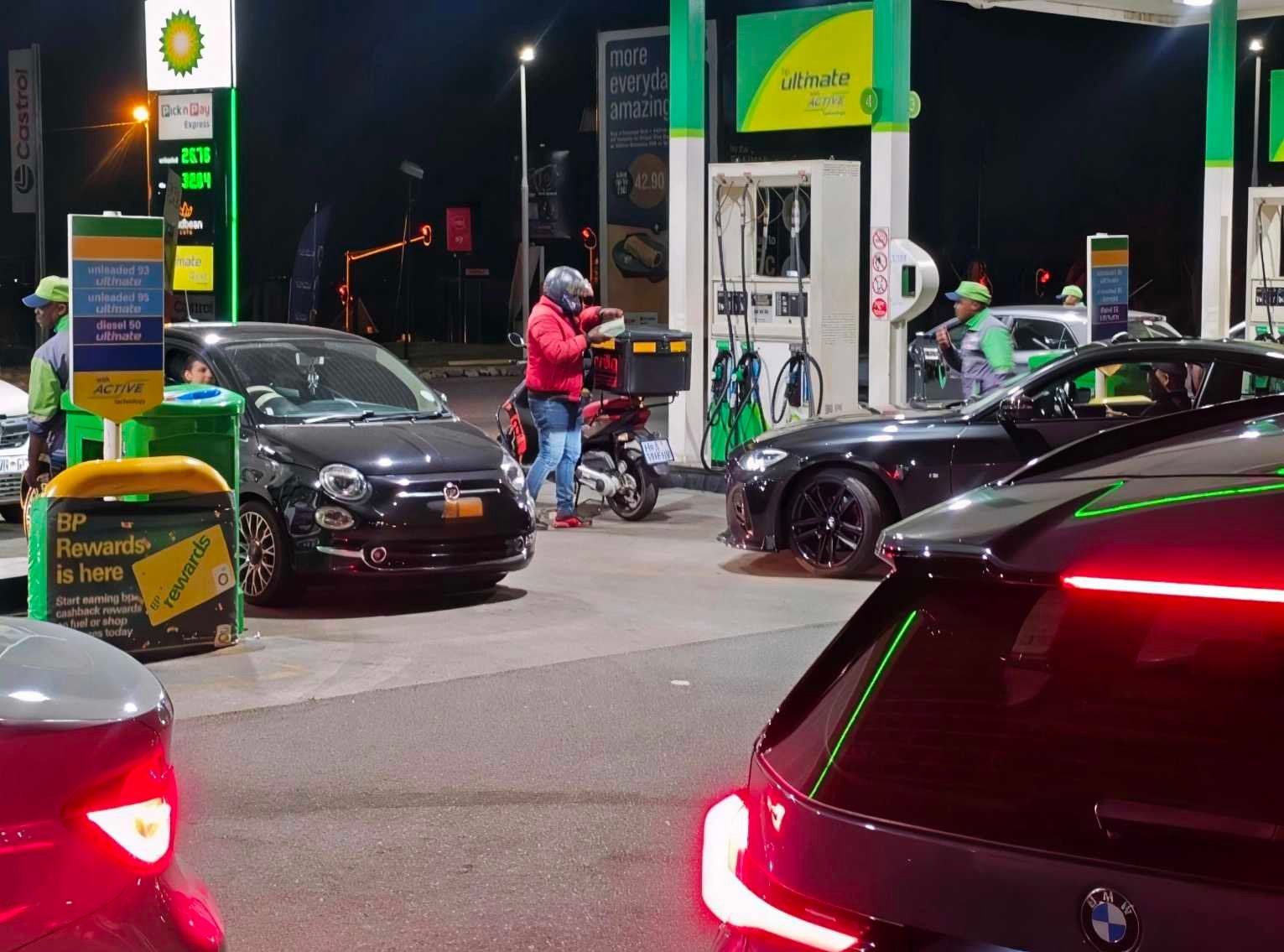
JOHANNESBURG — South African motorists have started queuing at some filling stations ahead of Tuesday midnight’s record fuel price increases, with one NOWinSA team member reporting long queues at two stations in Fourways.
The latest South Africa’s fuel price adjustment will see 95 petrol rise by R3.33 a litre and diesel by up to R3.24 from midnight.
The government has urged consumers to buy only what they normally need and avoid panic buying.
Motorists queue as fuel prices jump
At a BP station in Fourways, our team member found queues so long that some motorists said they had waited 10 to 15 minutes to be served.
He left and tried another station, only to encounter another long queue.
The scenes did not appear to reflect widespread panic buying. Our team saw no motorists trying to fill containers with extra fuel.
But the concern was clear.
One motorist said he was trying to squeeze in as much saving as possible before the higher prices took effect at midnight.
The government issued its own warning on Tuesday, saying unusually high demand could put pressure on filling stations and distribution networks.
“Consumers are encouraged to buy fuel to meet their normal needs and avoid panic buying.”
It also warned against unnecessary stockpiling, saying unusually high demand could contribute to localised shortages.
What the new petrol and diesel prices mean
The latest fuel price increases will push Gauteng’s 95 petrol price to R30.25 a litre, while 93 petrol rises to R29.88.
At the coast, 95 petrol will cost R29.38 a litre.
Wholesale 0.005% diesel rises by R3.24 to R33.29 a litre inland, while 0.05% diesel increases by R2.84 to R31.95.
For the full October fuel price breakdown, including the different inland and coastal prices, see our earlier report.
NADA said a motorist filling a 50-litre tank will pay between R156 and R166.50 more, depending on the petrol grade.
The association warned that higher fuel costs will also put pressure on taxi operators, commuters and businesses that transport goods and provide services.
Why October fuel prices have jumped
The Department of Mineral and Petroleum Resources fuel-price announcement said the increase follows a sharp rise in the average Brent crude oil price, from $87.89 to $101 a barrel during the review period.
The department attributed the increase to continued US/Iran tensions, uncertainty over oil flows through the Strait of Hormuz, higher shipping costs and decreasing inventories.
International petrol and diesel prices also increased because of supply shortages linked to lower global inventories.
The rand offered little relief, strengthening only marginally from 16.213 to 16.212 against the dollar during the review period.
Pressure grows for fuel-price relief
The latest increase has also revived calls for government intervention as petrol moves above R30 a litre inland.
The increase follows the September fuel price adjustment, which had already added pressure to motorists and household budgets.
The pressure also follows the temporary R3 fuel levy relief introduced earlier this year. The measure was eventually phased out, with the full levies restored from July.
Trade unions and political parties have since renewed calls for relief, although they have proposed different approaches.
COSATU has called for R10 billion from the Central Energy Fund’s Equalisation Fund to cushion consumers, while ActionSA has called for a fuel-levy reduction.
NADA vice chairperson Thembinkosi Pantsi said the impact extends beyond motorists.
“The journey to work does not get shorter when fuel becomes more expensive.”
The association said households are already balancing fuel, food, electricity, insurance, maintenance and borrowing costs, leaving less room to absorb another sharp increase.
The new fuel prices take effect from midnight on Tuesday, October 6, for Wednesday, October 7.