


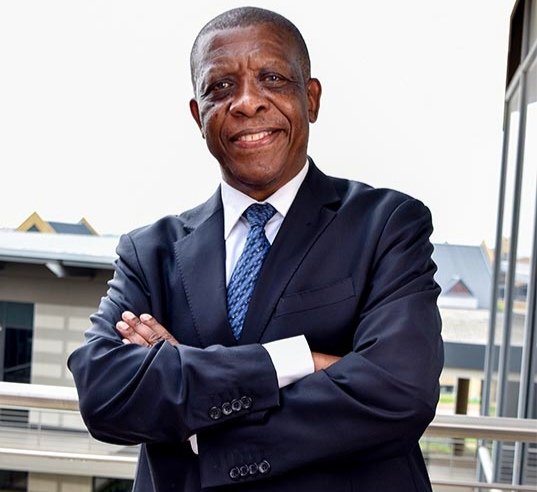
For more than three decades, Tim Modise has helped South Africans make sense of politics, democracy and a changing nation.
Now, North-West University (NWU) will recognise his contribution with an honorary doctorate.
The university will confer the degree at a special ceremony at the Great Hall on its Mahikeng Campus on Thursday, October 22, 2026.
The honour follows other recent recognition of influential cultural figures, including President Cyril Ramaphosa’s conferment of the Order of Ikhamanga on Oskido and Wouter Kellerman.
Their achievements underscore how media and entertainment personalities can inspire generations and contribute to social cohesion.
A broadcasting career shaped by democracy
Timothy Molefe “Tim” Modise is regarded as one of South Africa’s pioneering broadcasters and public communicators.
His career has tracked the country’s journey from apartheid to constitutional democracy.
He began as a sound technician at Radio 702 before becoming a music DJ. In 1988, he moved into public education talk, later pioneering politically oriented discussions that brought the country’s changing political landscape into South African homes.
His reporting covered the unbanning of liberation movements, the release of political prisoners and the negotiations that paved the way for democracy.
Modise has worked across major broadcasting platforms, including the SABC, eNCA, Business Day TV, 702, SAfm, Metro FM and M-Net’s Carte Blanche.
His career has also included BBC Radio, Radio Bop and Soweto TV. He also helped launch Power FM.
From the Mandela–de Klerk debate to national dialogue
Modise’s influence extends beyond the studio. During South Africa’s political transition in the 1990s, he used broadcasting to encourage public dialogue, political tolerance and informed citizenship.
In 1994, he served as a panellist during the televised debate between Nelson Mandela and FW de Klerk.
International broadcasters, including CNN, the BBC and the Australian Broadcasting Corporation, carried the debate to a global audience.
His biography puts that audience at 800 million. He has also interviewed every South African president since 1990.
Over the years, Modise has moderated policy discussions involving political leaders, business executives, academics, economists and artists.
His work has covered governance, the economy, education, health, labour and nation-building.
Honours beyond broadcasting
Modise’s contribution to public life includes his appointment by former president Thabo Mbeki as the founding chairperson of Proudly South African.
He later served as chief communications officer for the 2010 FIFA World Cup Local Organising Committee and became CEO of technology company Sizwe IT.
His accolades include SABC Broadcaster of the Year in 1991 and induction into the South African Radio Hall of Fame in 2011.
Archbishop Desmond Tutu also conferred a Reconciliation Award on him, while Spain’s Jaime Brunet Foundation presented him with an international human rights award.
Why NWU is recognising Tim Modise
NWU confirmed the honour in its official announcement.
Prof Gilbert Motsaathebe, deputy dean of teaching and learning in the Faculty of Humanities, said the degree recognises Modise’s contribution to broadcasting, public communication and democratic discourse.
“The honorary doctorate from the NWU recognises Modise’s distinguished contribution to South African broadcasting, public communication and democratic discourse, and his longstanding role in creating spaces for informed national conversation,” he said.
The recognition highlights how broadcasters can strengthen social cohesion by creating space for difficult conversations and helping audiences engage with different perspectives.
NWU has also recognised prominent South Africans through initiatives such as the Siya Kolisi Residence, which opened to help address student accommodation challenges.
Beyond broadcasting, Modise continues to engage audiences through The Tim Modise Connection, a podcast he founded and hosts.
Available on multiple online platforms, the show challenges the status quo and explores issues affecting society, businesses and institutions.
His honorary doctorate will recognise a career built on more than broadcasting — one that has helped South Africans engage with the debates shaping their country.